
The Next Standard: From Exercise Technician to Medical Exercise Professional
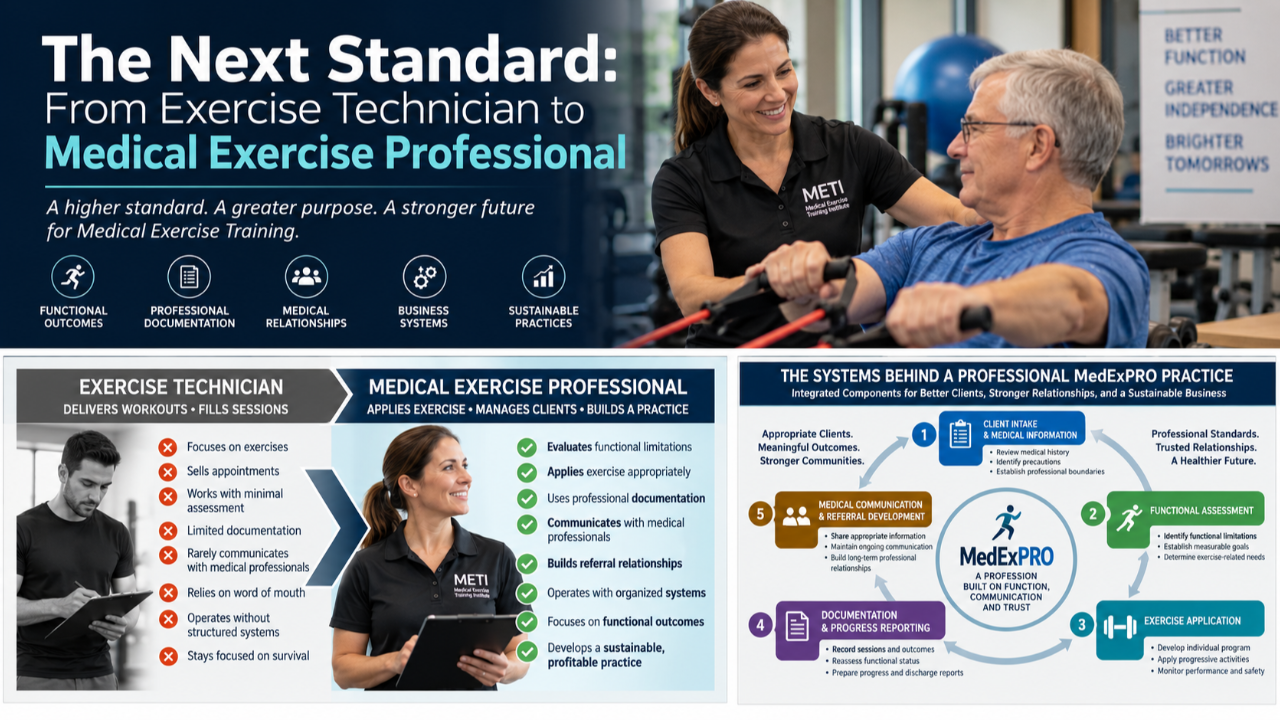
Why Certification Alone Is Not Enough—and Why the Future of Medical Exercise Training Depends on Professional Systems, Functional Outcomes, Documentation, and Medical Relationships
By Dr. Michael K. Jones, PhD, PT
Founder and President, Medical Exercise Training Institute
After 41 years as a physical therapist and 32 years teaching Medical Exercise Specialists, I believe it's time for us to have a serious conversation about the future of Medical Exercise Training.
And I want to begin with a question that may make some of my students and graduates uncomfortable.
Did you become a Medical Exercise Specialist to build a professional Medical Exercise Training practice, or did you simply want another certification that would allow you to charge more for personal training sessions?
Think about that question for a moment.
Since we conducted our first Medical Exercise Specialist (MES) workshop in Washington, DC, in July 1994, I've watched this profession grow from a relatively unfamiliar ...
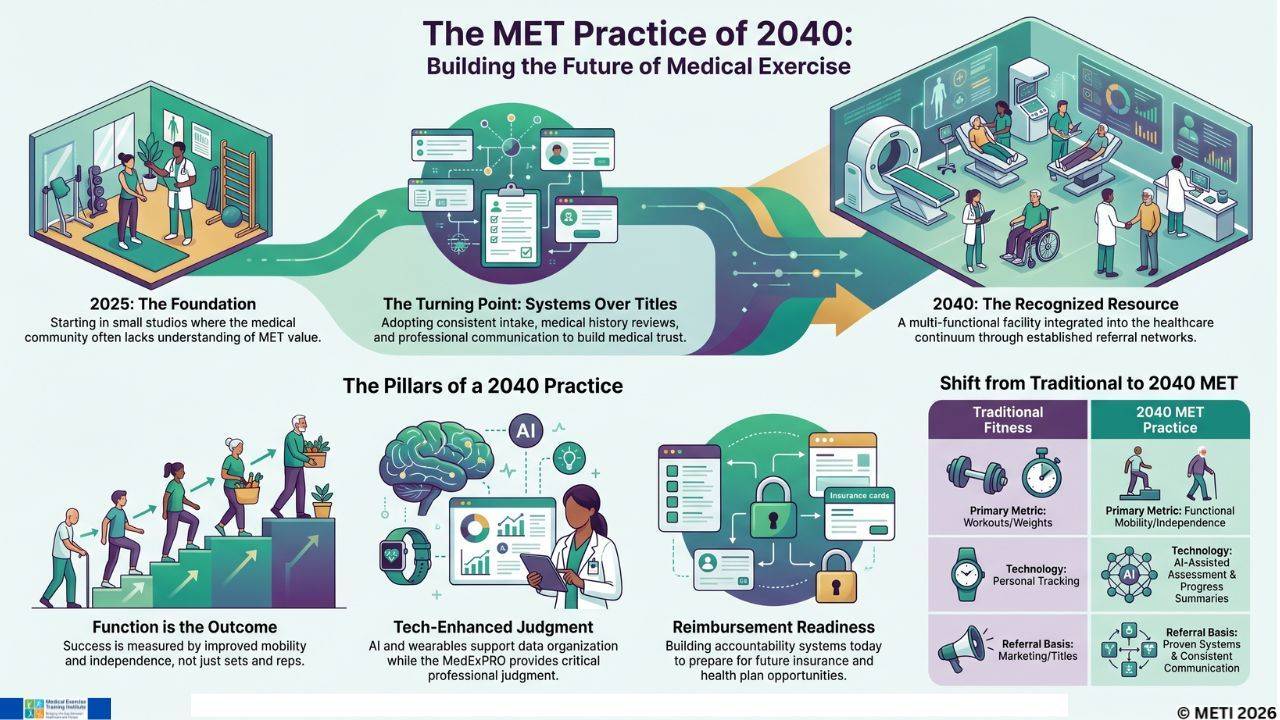
The Medical Exercise Practice of 2040 Starts Today
Disclaimer: This is a fictional, forward-looking article based on my personal vision of what Medical Exercise Training could become by 2040. It is not a statement of current policy, reimbursement, regulation, or future guarantees.
I want you to imagine a Medical Exercise Training practice in the year 2040.
You walk into a professional facility that does not feel like a traditional gym. One area is dedicated to assessment, another to progressive strength, mobility, stability, endurance, and functional training, and another supports hybrid or remotely monitored exercise programs. The clients are not there simply to “work out.” Many have completed physical therapy or other medical care and are now working with Medical Exercise Professionals to improve function, independence, and long-term capacity.
This is the practice of Jodie Hicks, MES.
But Jodie did not start with a large facility, a large staff, or an extensive referral network. In 2025, she operated from a small rented studio an...
Mrs. Jacobs, Medicare and the MedExPRO
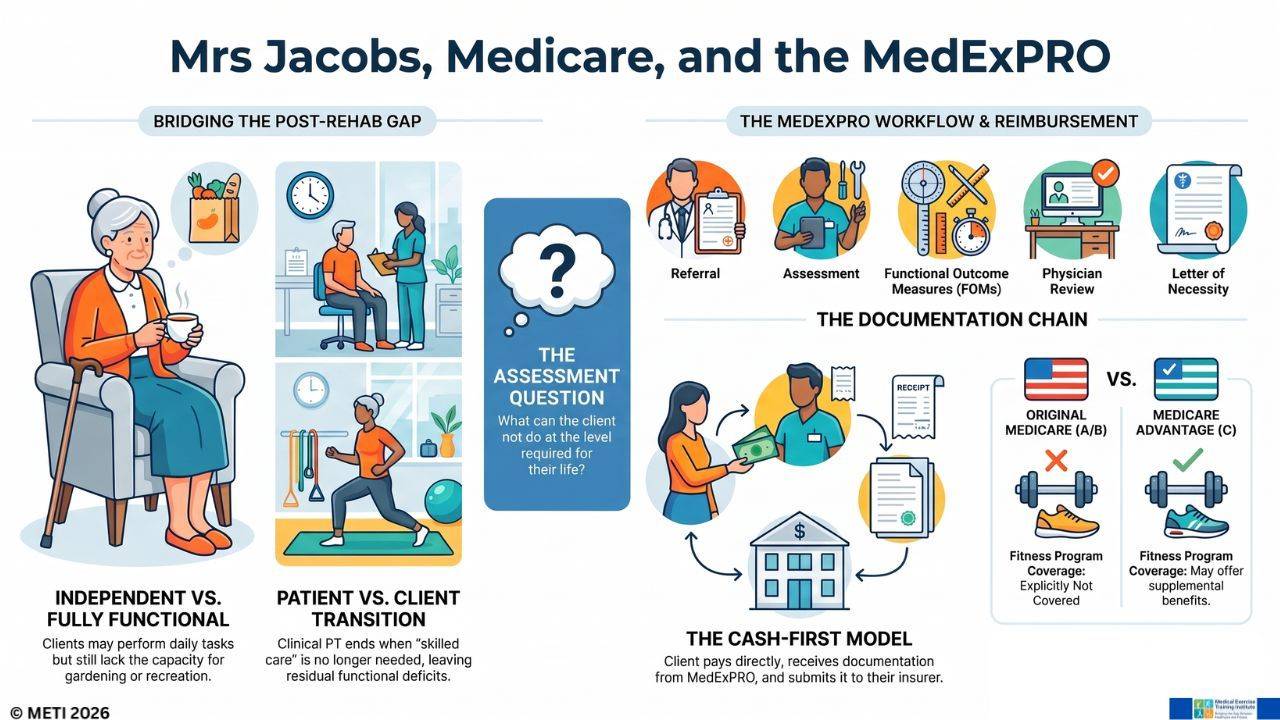
Understanding the Medicare Client, the Post-Rehabilitation Gap and Cash-First Reimbursement
Mrs. Jacobs is a 72-year-old retired professional who lives independently with her husband. She enjoys gardening, attending church, shopping, traveling, volunteering, and spending time with her grandchildren. She occasionally helps with administrative activities in a family business.
Several months ago, Mrs. Jacobs underwent a right total knee replacement. Her journey from surgery through rehabilitation and eventually into Medical Exercise Training provides an important lesson for every MedExPRO who works with Medicare-age clients.
The lesson is simple:
Being independent does not necessarily mean being fully functional.
Understanding that distinction—and understanding where Medicare ends and Medical Exercise Training begins—is essential to professional medical exercise practice.
Understanding Mrs. Jacobs' Medicare Coverage
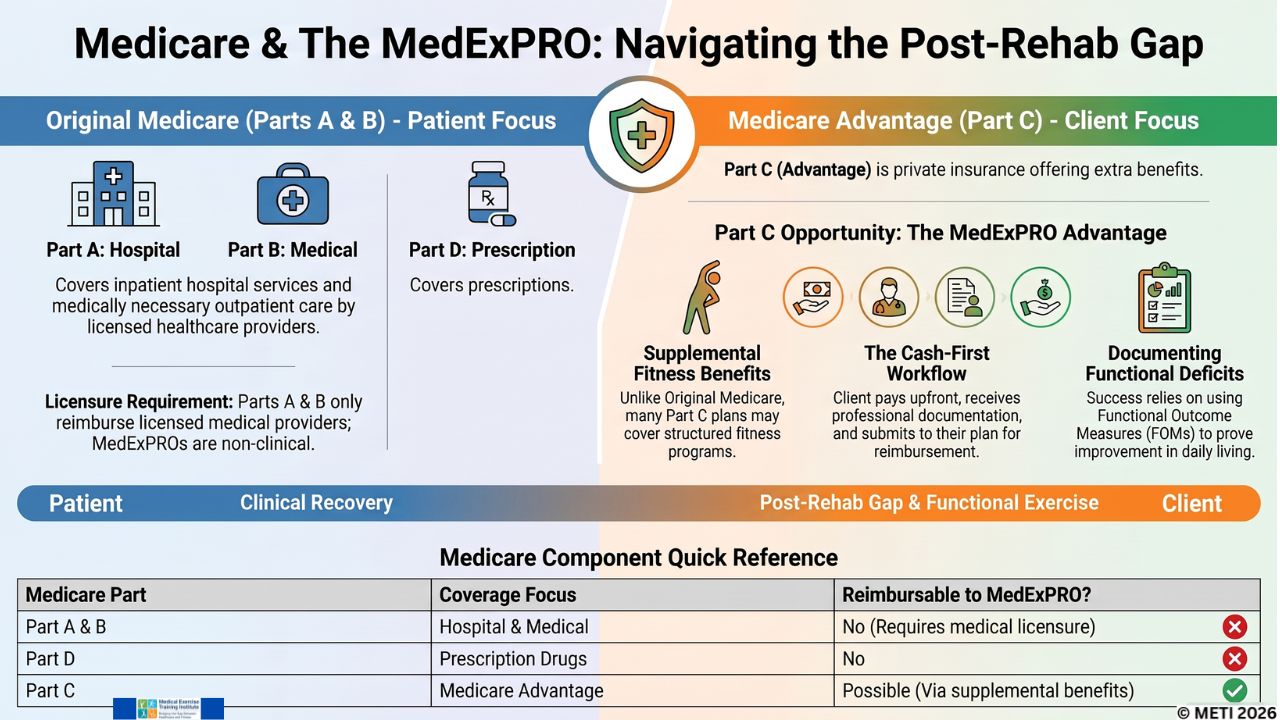
Mrs. Jacobs entered Medicare at age 65. Medicare consists of sev...
The MedExPRO Periodic Table - The Elements of a Successful Practice
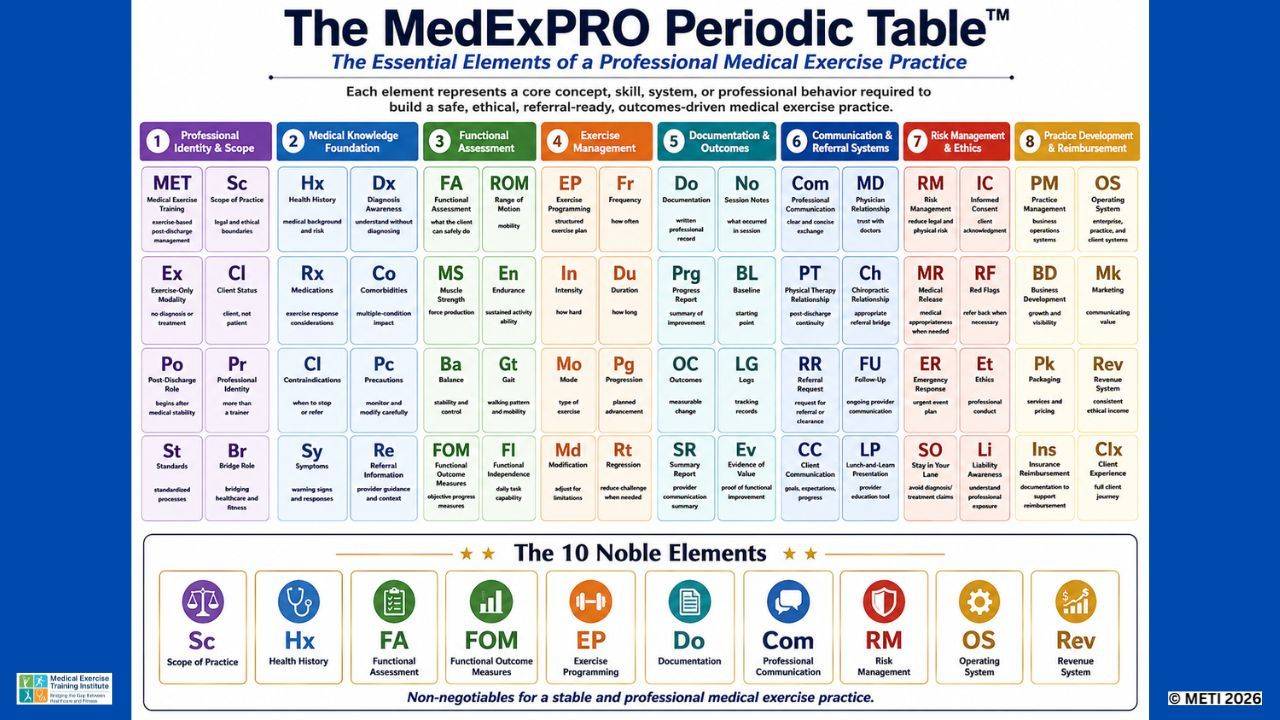
The MedExPRO Periodic Table™: The Essential Elements of a Professional Medical Exercise Practice
The fitness industry has spent decades attempting to step closer to healthcare. Personal trainers and fitness instructors routinely employ terms like "corrective exercise," "post-rehab," "medical fitness," "functional training," and "therapeutic exercise." While some of these concepts possess inherent value, their loose application often generates more confusion than clarity. If we expect physicians, physical therapists, chiropractors, senior living administrators, and insurance carriers to take our work seriously, Medical Exercise Training (MET) must be fundamentally different. We must define our role, establish clear professional boundaries, and show how assessment, programming, documentation, and business operations work together in a structured, repeatable system.
For the Medical Exercise Professional (MedExPRO) working with clients with medical conditions, professionalism is not buil...
The 10 Pillars of Professional Practice: Moving Beyond Fitness with a Medical Flavor
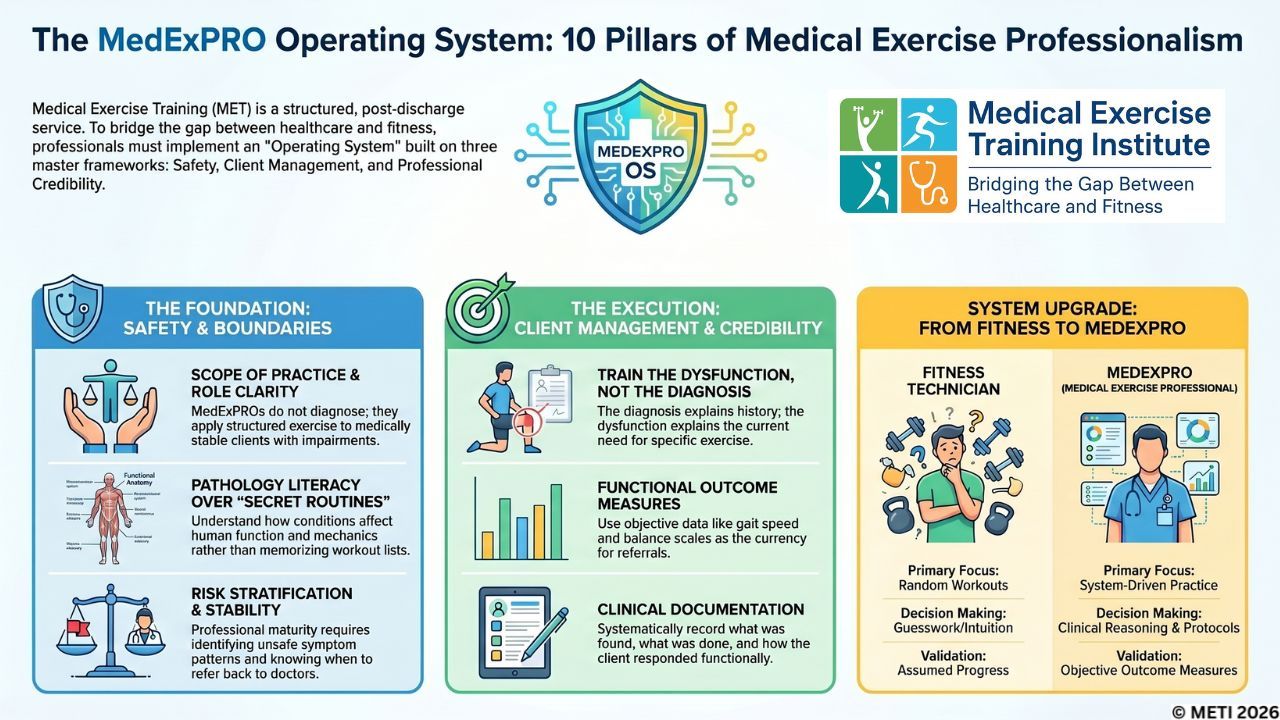
To transition fitness professionals from a "workout-centric" mindset to a system-driven, professional practice model by mastering the 10 key concepts of Medical Exercise Training.
Medical Exercise Training (MET) is not general fitness with a medical flavor. It is a structured, post-discharge, exercise-based professional service. To earn medical referrals and build a sustainable practice, the Medical Exercise Professional (MedExPRO) must move from technician thinking to professional practice ownership by installing systems for safety, client management, and professional credibility.
Professional Standard
Many fitness professionals believe that working with clients who have medical conditions simply requires knowing a few extra exercises. They look for the "secret routine" or a collection of specialized workouts.
But medical professionals do not refer to routines. They refer to systems.
If you want to bridge the gap between healthcare and fitness, you must move beyond the mentality ...
Medical Exercise Training eBook Tip 52: How & When to Discharge A MET Client
Welcome back to the MET 101 eBook series! In Tip 52, Dr. Mike addresses a transition that separates general personal trainers from true Medical Exercise Professionals (MedExPROs): How and when do you discharge a Medical Exercise (ME) client?
If you want to be fully integrated into the healthcare network, you must understand that ME clients are not meant to stay ME clients forever.
The Goal is Independence, Not Dependence: The fundamental goal of every healthcare provider—from surgeons to physical therapists—is to get the patient to a point where they no longer need intensive care, requiring only supervision or periodic check-ins. The exact same holds true for MedExPROs.
A trap that many fitness professionals fall into is wanting to hold onto a medical exercise client indefinitely because they can charge a higher premium for those specialized services. However, once a client's function, power, strength, and proprioception have significantly improved, they no longer require the advanc...
Why So Many MedExPROs Struggle to Grow a Strong Practice—And What to Do About It
Most Medical Exercise Professionals do not fail because they lack passion, care, or technical knowledge.
They struggle because they are trying to grow a practice without a clear structure behind it.
They know how to work hard.
They know how to help people.
They know their clients need them.
But behind the scenes, too many MedExPROs are still asking the same questions:
What should I be documenting?
How do I communicate with physicians, physical therapists, and chiropractors?
How do I make my services easier to explain?
How do I attract the right clients?
How do I build a practice that feels organized, professional, and profitable?
That is where the real problem begins.
A lot of good MedExPROs are delivering solid service, but their practice still feels scattered. Their message is unclear. Their systems are inconsistent. Their documentation is weak. Their communication is irregular. Their pricing may not reflect the value they provide. And because of that, growth feels harder than ...
MedExPRO….Do MET Clients Stay Clients Forever? Understanding Functional Maintenance
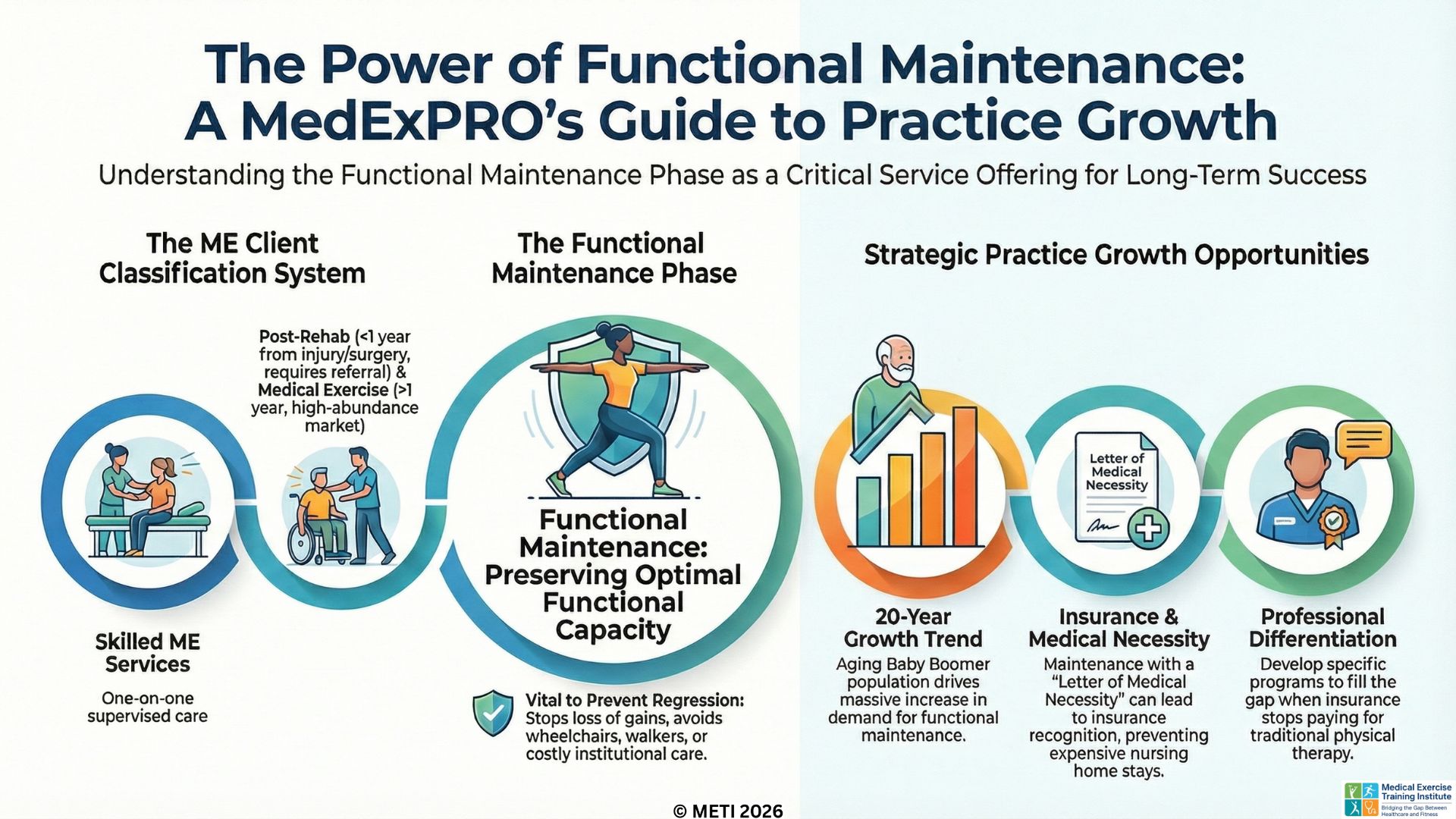
Welcome back to the MET 101 eBook series! In Tip 51, we address a very common and important question for Medical Exercise Professionals (MedExPROs): Do MET clients remain MET clients forever?
The short answer is no. Just as medical treatment eventually concludes, skilled MET services—which involve intensive one-on-one or group-based supervision—also reach a conclusion. At a certain point, a client achieves their optimal functional capacity and no longer needs primary MET services. When this happens, they transition into a critical phase known as Functional Maintenance.
The 4 Post-Rehab Client Classifications: To understand where Functional Maintenance fits in, it helps to understand the four primary classifications of clients you will see in your practice:

- The Post-Rehab Client: This client has sustained an injury, undergone surgery, or been diagnosed with a condition within the last year. They always require a medical referral before you begin working with them.
- The Medical ...
MedExPRO - Neck Pain Isn’t Just Pain—It’s Lost Function—Can You Measure Functional Improvement
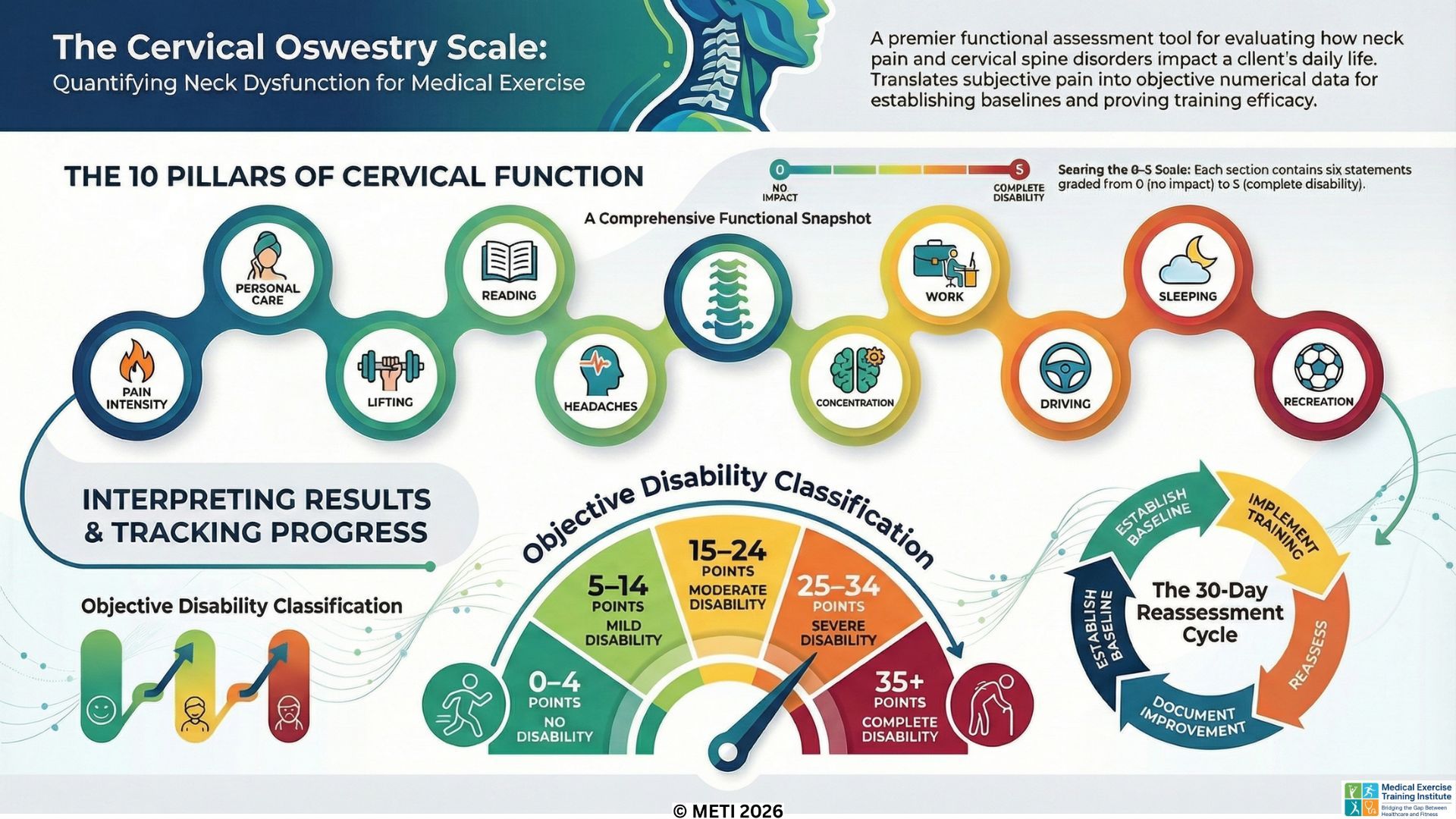
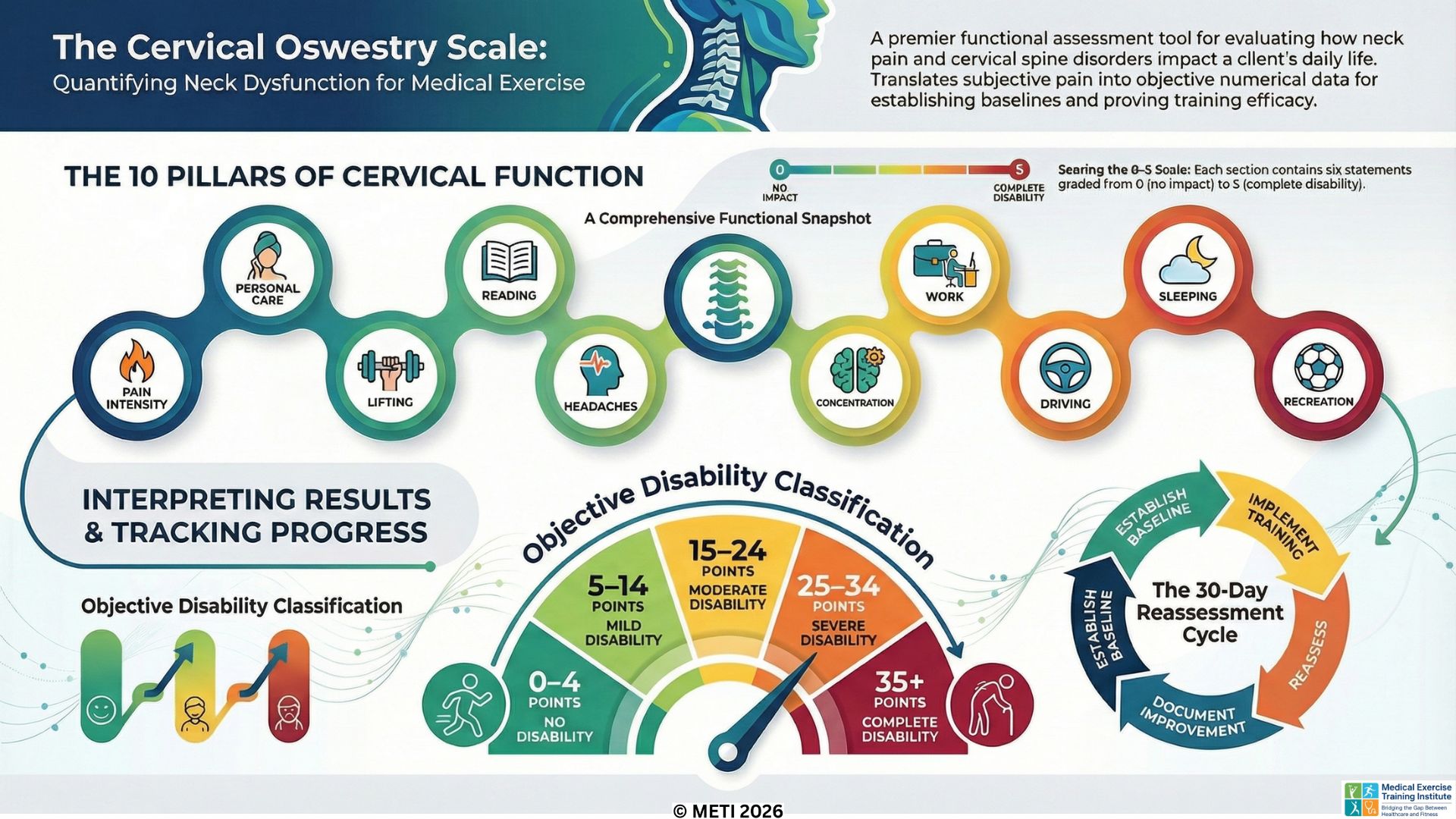
The Cervical Oswestry Scale: Measuring the True Cost of Neck Dysfunction
Just as the Lumbar Oswestry Scale measures lower back dysfunction, the Cervical Oswestry Functional Assessment Scale is the premier tool for evaluating clients with cervical spine disorders. Also developed by Dr. Gordon Waddell, this questionnaire-based scale takes a comprehensive "snapshot" of how neck pain, stiffness, and cervical limitations impact a client's overall lifestyle and daily activities. For Medical Exercise Professionals (MedXPROs) managing conditions like cervical strain or disc herniations, this tool is vital for setting baselines and proving program efficacy.
Get the Podcast Here
The Cervical Oswestry Scale consists of 10 specific sections, each containing six statements graded from 0 to 5. The sections cover Pain Intensity, Personal Care, Lifting, Reading, Headaches, Concentration, Work, Driving, Sleeping, and Recreation. This scale is uniquely tailored to the symptoms most frequently assoc...
Medical Exercise Specialist Snapshot of Lumbar Function
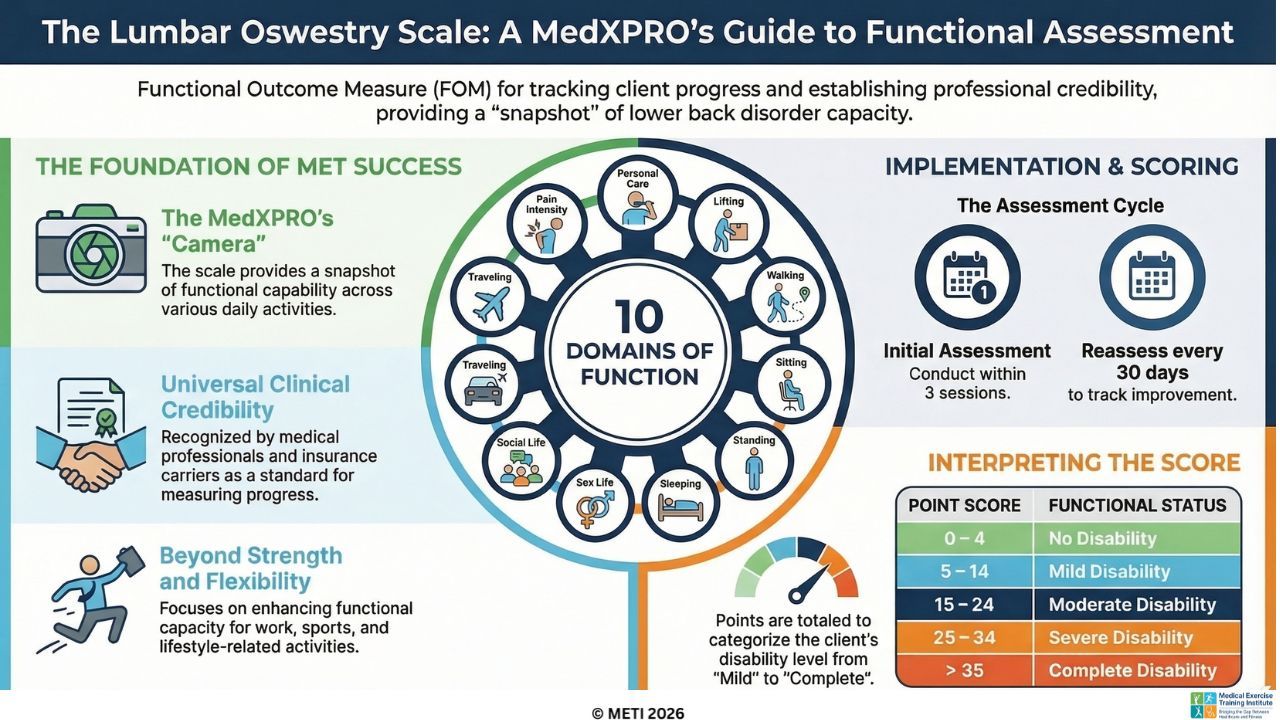
For Medical Exercise Professionals (MedXPROs) managing clients with low back pain and lumbar spine disorders, the Oswestry Lumbar Scale is an indispensable functional assessment tool. Developed by Scottish industrial rehabilitation physician Gordon Waddell, this scale translates the subjective experience of back pain into a concrete, objective numerical value. Rather than merely testing a client's lumbar range of motion or isolated muscle strength, the Oswestry Scale uses a battery of targeted questions to determine exactly how a lumbar condition impacts a client's daily functional capacity.
The Lumbar Oswestry Scale is divided into 10 distinct sections, each addressing a critical aspect of daily living. These sections include Pain Intensity, Personal Care (such as washing and dressing), Lifting, Walking, Sitting, Standing, Sleeping, Sex Life, Social Life, and Traveling. Within each section, the client selects from six statements that best describe their current level of function or l...