
The Medical Exercise Practice of 2040 Starts Today
Disclaimer: This is a fictional, forward-looking article based on my personal vision of what Medical Exercise Training could become by 2040. It is not a statement of current policy, reimbursement, regulation, or future guarantees.
I want you to imagine a Medical Exercise Training practice in the year 2040.
You walk into a professional facility that does not feel like a traditional gym. One area is dedicated to assessment, another to progressive strength, mobility, stability, endurance, and functional training, and another supports hybrid or remotely monitored exercise programs. The clients are not there simply to “work out.” Many have completed physical therapy or other medical care and are now working with Medical Exercise Professionals to improve function, independence, and long-term capacity.
This is the practice of Jodie Hicks, MES.
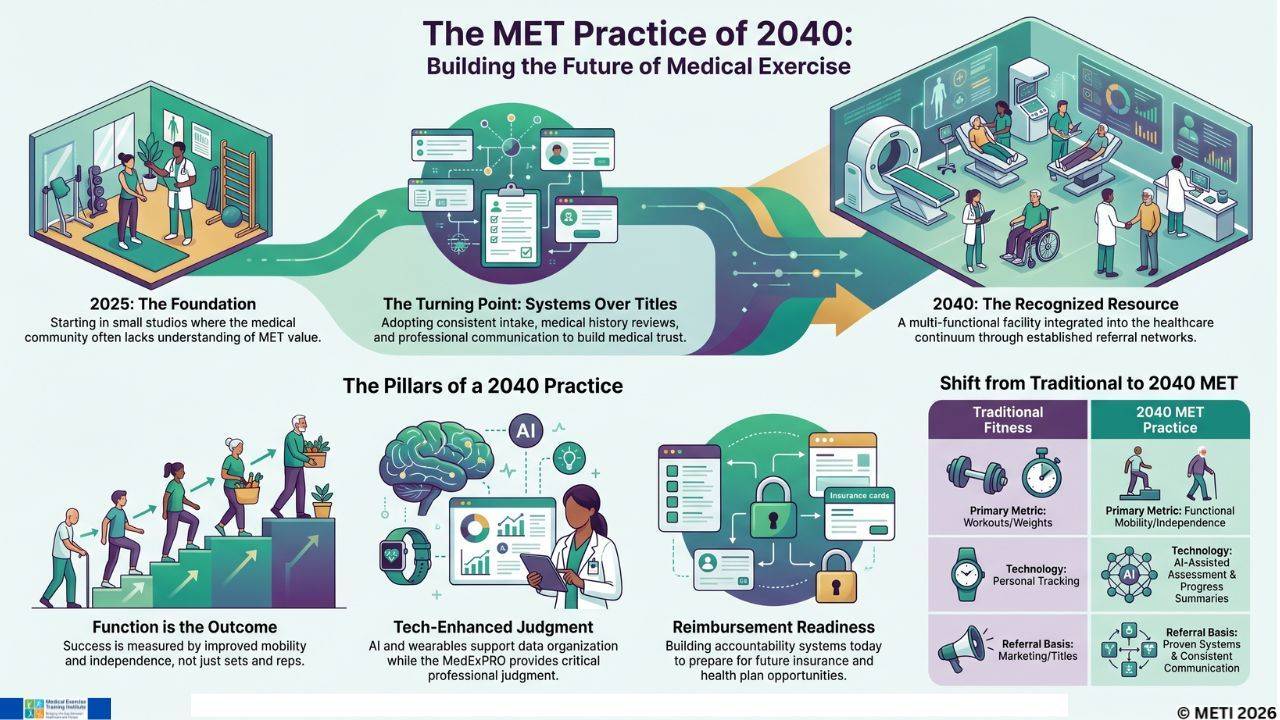
But Jodie did not start with a large facility, a large staff, or an extensive referral network. In 2025, she operated from a small rented studio and had only a few medical relationships. She knew one chiropractor and one physical therapist. Like many new Medical Exercise Specialists, she believed in the value of what she was doing, but she quickly discovered that the medical community did not automatically understand what Medical Exercise Training was or how it fit between rehabilitation and conventional fitness.
That forced Jodie to make an important change. She stopped trying to explain her value only through titles and marketing. Instead, she began demonstrating it through the way she managed clients.
She created a consistent intake process, reviewed medical histories, obtained appropriate releases, completed assessments within scope, identified functional limitations that could be addressed with exercise, and documented progress. She also communicated with referring professionals so they understood what happened after the referral.
That was the turning point.
Jodie realized that becoming an advanced MedExPRO required more than selecting good exercises. It required a professional system. She began asking different questions: What functional limitation am I addressing? What did the assessment show? What outcome are we trying to improve? How will I measure progress? When should the client be reassessed? What information should be communicated to the referring provider? Is anything occurring that requires referral back to the medical professional?
Over time, those questions shaped her entire practice.
By 2040, Jodie’s practice has become a recognized regional resource for individuals who are beyond rehabilitation but still need structured exercise to improve function. Physicians, physical therapists, chiropractors, and other healthcare professionals understand what happens when they refer someone to her. They know she will remain within scope, communicate appropriately, and send the client back when something requires medical evaluation.
That predictability created trust, and trust created referrals.
The most important difference between Jodie’s practice and a traditional fitness business is what she measures. She does not define success by the number of workouts completed or the amount of weight lifted. She looks at function.
A client following knee replacement is not successful simply because she completed three sets of an exercise. She is successful because her mobility, strength tolerance, and endurance have improved enough to help her return to meaningful daily activities. An older adult is not successful because he used a leg press. He is successful because he can climb stairs, walk farther, reduce fall risk, and maintain greater independence.
That is the distinction I believe will continue to shape Medical Exercise Training.
Exercise is our modality. Function is the outcome.
By 2040, technology is also a major part of Jodie’s practice. Wearables track activity and adherence. Exercise equipment records workload and progression. Artificial intelligence helps organize assessments, compare reassessment data, and prepare draft progress summaries. Some clients complete part of their program remotely.
But technology does not replace the MedExPRO. It makes professional judgment even more important.
The future Medical Exercise Professional must understand why an exercise is being used, what functional problem it is intended to address, how progress should be measured, and when something falls outside the professional’s scope.
Reimbursement is another part of this fictional future. In this vision, some insurers and health plans support structured Medical Exercise Training for selected clients for limited periods and sessions. But I do not believe reimbursement would expand simply because exercise is valuable. The stronger case will come from measurable functional outcomes, appropriate referrals, clear documentation, professional communication, and consistent systems.
That is why reimbursement readiness matters now.
You do not become reimbursement ready when an insurer decides to pay. You become reimbursement ready by building the systems that demonstrate accountability before the opportunity arrives.
That brings us back to the present.
The real purpose of imagining 2040 is not to predict the future. It is to ask what we need to build today.
We need stronger professional standards, better assessment skills, clearer documentation, better communication with physicians and therapists, measurable functional outcomes, consistent client-management systems, stronger referral relationships, and greater clarity around scope.
After more than three decades in Medical Exercise Training, one lesson continues to stand out for me: certification alone is not enough. Certification provides knowledge, but application develops competence. Systems create consistency. Documentation creates accountability. Communication creates relationships. Measurable outcomes create credibility.
Put those together and we begin creating more than a certification.
We begin creating a profession.
Key Takeaways
- Medical Exercise Training must remain focused on measurable function.
- Professional systems are essential for assessment, documentation, communication, reassessment, and referral management.
- Medical referrals are built through trust, consistency, communication, and clear scope.
- Reimbursement readiness must be developed before reimbursement opportunities expand.
- Artificial intelligence can support the MedExPRO, but it cannot replace professional judgment.
- Certification is the beginning; professional application is what builds the practice.
- The future of Medical Exercise Training will be shaped by what MedExPROs build today.
The Medical Exercise Training practice of 2040 described here is fictional. But the professional standards, systems, relationships, and habits that could create practices like it are decisions we can begin making right now.
Closing disclaimer: This article reflects the author’s vision of one possible future and should not be interpreted as current or guaranteed future policy, reimbursement guidance, or regulatory standards.

Get Medical Exercise Training guidelines and updates!
Build your practice with tips learned over 28+ years teaching MedXPROs around the world!!