
MedExPRO Operating System: The Architecture of a Medical Exercise Practice
For decades, the fitness industry has operated largely on enthusiasm, creativity, and intensity. Trainers sell workouts, chase trends, and trade time for money. However, when managing clients with chronic medical conditions—such as total joint replacements, diabetes, or neurological disorders—enthusiasm is not enough. It requires infrastructure. It requires a standardized "Operating System" that transforms a personal trainer into a Medical Exercise Professional (MedExPRO).
Based on the Medical Exercise Training Institute (METI) standards, the MedExPRO Operating System is not merely a workout philosophy; it is a comprehensive professional architecture. It creates an evidence-based, scalable practice capable of interfacing with the medical community.
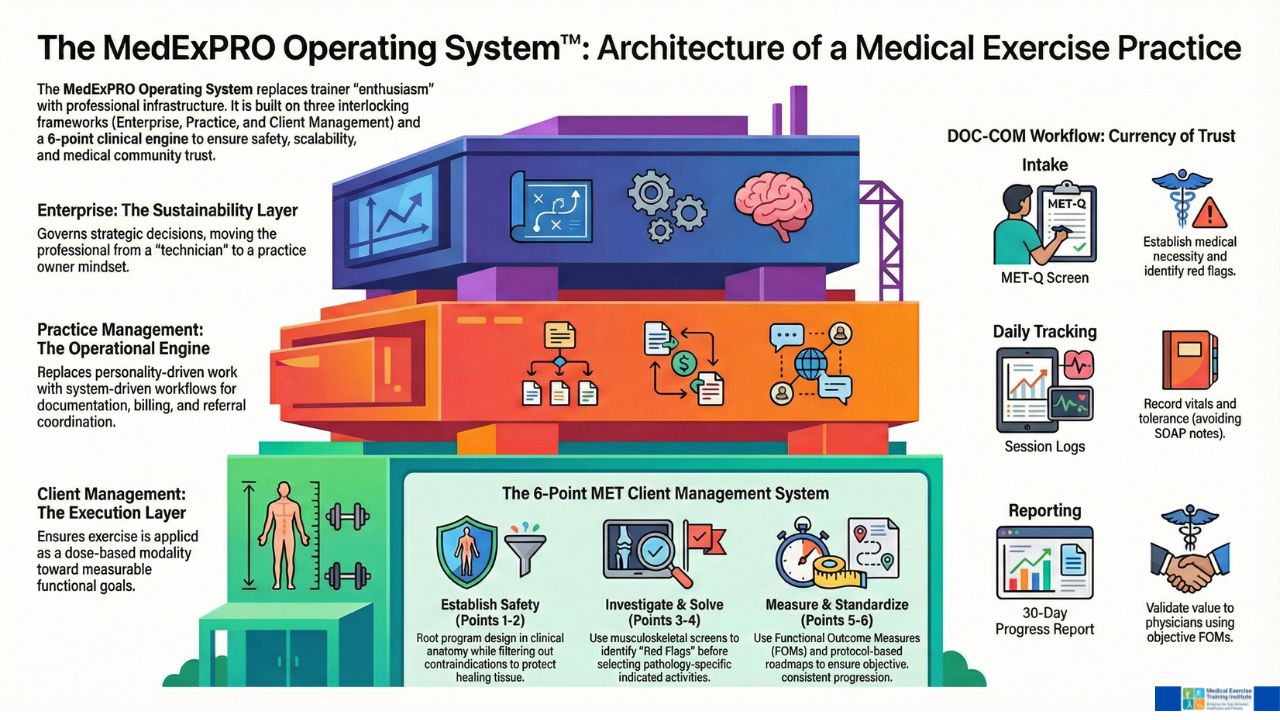
This system is built upon three interlocking frameworks: Enterprise, Practice Management, and Client Management. This article outlines how these systems function together to bridge the gap between healthcare and fitness, moving practitioners from "improvisational fitness" to "defensible medical exercise management."
- The Foundation: The Three Interlocking Frameworks
A medical exercise practice cannot survive on exercise skills alone. It requires three distinct layers of governance to ensure sustainability, consistency, and outcomes. These frameworks must operate vertically to support the professional.
The Enterprise Framework (Sustainability & Strategy) This is the leadership level. It governs decisions above daily operations, asking the critical question: Can this practice survive, grow, and remain ethical?. It moves the professional from a "technician" mindset to an "owner" mindset. The Enterprise Framework dictates the business model, financial planning, risk management, and strategic alliances. Without this framework, a MedExPRO is simply a freelancer with a job, not a practice owner.
The Practice Management Framework (Operations & Infrastructure) This is the operational engine. It translates high-level strategy into consistent, repeatable daily actions. It answers the question: Does this practice operate consistently regardless of who is working? Healthcare systems do not partner with personalities; they partner with processes. This framework governs intake workflows, documentation standards, billing, and referral coordination. It replaces memory-based operations with system-driven workflows, ensuring that no client falls through the cracks.
The Client Management Framework (Exercise & Outcomes) This is the exercise delivery level. It governs how clients are managed from the moment of medical clearance to their eventual discharge or transition to maintenance. It answers the question: Are clients progressing safely toward measurable functional goals? This framework ensures that exercise is applied as a specific, dose-based modality rather than a random activity.
- The Engine: The 6-Point Client Management System
At the heart of the Client Management Framework lies the 6-Point Medical Exercise Training (MET) Client Management System. This is the standard operating procedure for delivering care. It prevents "random exercise" and ensures that critical details regarding a client’s pathology are managed systematically.
- Clinical Anatomy & Pathology: This is the "bedrock" of the system. A MedExPRO cannot manage a condition they do not understand. Program design must target specific structures based on a deep understanding of the "Big Five" sciences: anatomy, pathology, biomechanics, kinesiology, and exercise physiology.
- Contraindications (The "Stop" Signs): Knowing what not to do is half the battle. This step requires identifying activities, positions, or intensities that increase inflammation or risk injury. The MedExPRO must filter out contraindicated movements before selecting any exercises to protect the healing curve of the tissue.
- Assessment (The Investigation): Assessment is not a workout; it is an investigation. You must approach the client with a detective’s mindset—"facts and only the facts". This includes a thorough medical history review and the 11-Point Musculoskeletal Screen to determine medical stability and identify "Red Flags" (e.g., radiating pain, unstable vitals) that require immediate referral back to a physician.
- Indicated Activities (The Solution): Only after safety is established do we select exercises. These activities must be defensible based on the client’s functional deficits and the specific pathology. Every exercise must have a functional purpose rooted in the client's anatomy.
- Progression & Functional Goals: Progression is criteria-based, not calendar-based. Goals must be functional (e.g., "return to gardening," "walk 20 minutes"), measurable, and documented using Functional Outcome Measures (FOMs). FOMs provide the objective data necessary to prove efficacy to insurance carriers and physicians.
- Protocol-Based Approach: Using standardized protocols (e.g., for Total Hip Replacement or Spinal Stenosis) ensures consistency. Protocols do not limit creativity; they provide the guardrails that allow you to safely customize the program while ensuring no step is missed. They serve as a roadmap for managing the condition while training the client.
- The Operational Backbone: The 10 Practice Management Systems
While the 6-Point System manages the client, the 10 Practice Management Systems manage the business operations. These systems create the infrastructure required to handle medical referrals and potential reimbursement.
- Operations System: Governs the physical plant, equipment safety, and HIPAA compliance.
- Documentation System: Ensures every interaction is recorded within 24 hours using standardized forms.
- Communication System: mandates the flow of information to medical providers (e.g., the 30-day progress report).
- Medical Relations System: Structured strategies for building trust with physicians, identifying gatekeepers, and maintaining professional boundaries.
- Billing & Scheduling System: Manages fee collection, invoicing, and CPT coding for reimbursement.
- Staffing & Education System: Ensures all staff meet the specific competency standards required for medical exercise.
- Marketing System —establishes ethical positioning that clearly differentiates medical exercise from fitness while supporting professional credibility and referral readiness.
- Client Management System — provides a structured process for intake, exercise, progression, follow-up, and transition to ensure consistent and professional client experiences.
- Assessment System —guides condition-based screening, functional assessment, and reassessment to support safe, structured service delivery.
- Business Development —establishes the strategic framework for growth, partnerships, pricing, and service expansion to ensure operational sustainability.
Implementing these systems prevents the practice from becoming "personality-dependent" and ensures scalability.
- The Currency of Trust: Documentation & Communication
In the MedExPRO Operating System, if it isn't written, it didn't happen. Documentation is not administrative busywork; it is your liability shield, your primary marketing tool, and the evidence required for reimbursement.
The "DOC-COM" Workflow:
- Intake: Use a standardized MET-Q (Medical Exercise Training Questionnaire) to establish medical necessity, identify the diagnosis, and screen for red flags.
- Session Logs (Not SOAP Notes): MedExPROs should strictly use Session Logs to record sets, reps, client tolerance, and vital signs. SOAP notes should be avoided as they are associated with licensed therapists and can create confusion regarding scope of practice.
- The 30-Day Progress Report: Every 30 days, a one-page report summarizing functional changes (using objective FOMs) is sent to the referring physician. This report is the "best marketing" you can do, as it proves your value to the medical team and keeps you top-of-mind.
- Discharge Summary: When the program concludes, a final report summarizes the outcomes achieved and recommends the next steps for the client, closing the professional loop.
- Scope of Practice: The "Exercise Only" Standard
The MedExPRO Operating System functions strictly within a non-diagnostic, non-treatment scope. The professional affirmation is: "I provide exercise, not treatment".
- Role: Manage the medical condition using exercise as the sole modality.
- Boundaries: You do not diagnose, manipulate tissue, offer medical advice, or interpret diagnostic imaging. You manage the residual functional deficits remaining after medical treatment has concluded.
- Language: You work with clients, not patients. You provide training, not therapy.
- Red Flags: The system requires immediate referral back to a medical professional if specific warning signs appear, such as radiating pain, unexplained swelling, or unstable vitals.
- Revenue & Sustainability: The "Practice" Mindset
Transitioning from a "fitness business" to a "medical exercise practice" requires a shift in how revenue is generated. The Operating System prioritizes recurring revenue, long-term management, and diversified income streams over transactional session sales.
- Referral Systems: Referrals are not "sales leads"; they are transfers of trust. They are earned by communicating outcomes to physicians using their language ("MedSpeak").
- Reimbursement Readiness: While reimbursement is not guaranteed, the system prepares you for it. By requiring a physician’s referral, establishing medical necessity, and tracking FOMs, your practice becomes "reimbursement-ready" for third-party payers (e.g., Workers' Comp, Auto Insurance). MET services are typically billed under CPT codes like 97110 (Therapeutic Exercise) or 97530 (Therapeutic Activities).
- Multiple Income Streams: A robust practice diversifies beyond 1-on-1 training. The system encourages Condition-Based Group Training (e.g., "Diabetes & Exercise" groups), which are finite, education-based programs that physicians love to refer to. Additionally, Medical Memberships provide a "step-down" option for clients who have finished their acute phase but need ongoing, supervised maintenance.
Conclusion: Moving from Trainer to Provider
Implementing the MedExPRO Operating System means adopting a new professional identity. It requires the discipline to assess before you train, the diligence to document every session within 24 hours, and the humility to respect the boundaries of your scope.
By implementing these frameworks—Enterprise, Practice Management, and Client Management—you do not just build a business; you build a vital link in the continuum of care. You create a practice that physicians trust, insurers recognize, and, most importantly, clients rely on for their long-term functional independence.
See where your medical exercise/fitness business is now. Review the “Referral & Reimbursement-Readiness Checklist”. Click HERE and see where you are.
Get Medical Exercise Training guidelines and updates!
Build your practice with tips learned over 28+ years teaching MedXPROs around the world!!