
Building Practice Infrastructure: Why Skill Alone Will Never Make You Referral-Ready
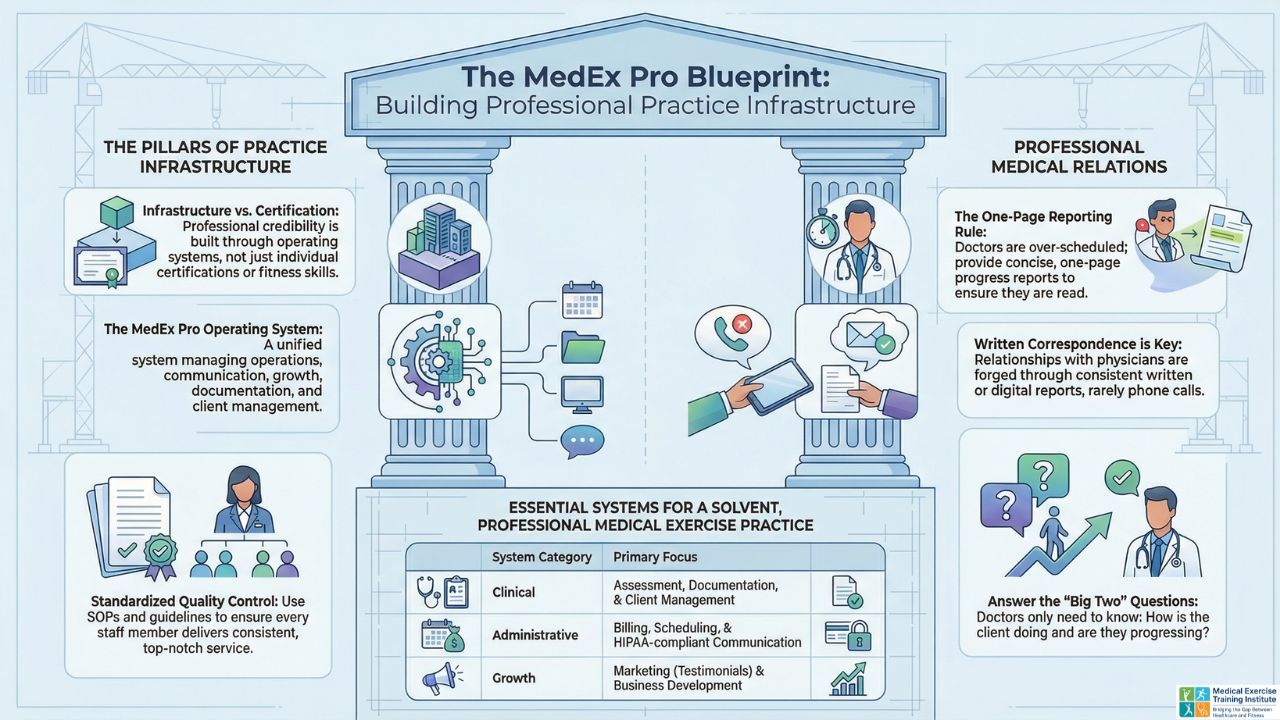
From Fitness to Medical Exercise: Building a Systems-Driven Practice
There is a dangerous myth that continues to undermine otherwise capable medical exercise professionals. It is the belief that increasing exercise-knowledge automatically increases professional credibility. Many assume that if they master more corrective variations, memorize more progressions, and accumulate more certifications, they will naturally become referral-ready.
That assumption is false.
You can know every regression of a glute bridge, every rotator cuff progression, and every balance drill available in continuing education. You can design technically sound programs and still fail to build a professional practice. Why? Because professional practices are not built on activity. They are built on infrastructure.
In medical exercise, activity is not enough. Systems are what create stability, defensibility, and sustainability.
This installment in the MedExPRO Operating System series addresses a central truth: sessions generate revenue temporarily, but systems generate credibility permanently. And credibility is what drives referrals, retention, and long-term viability.
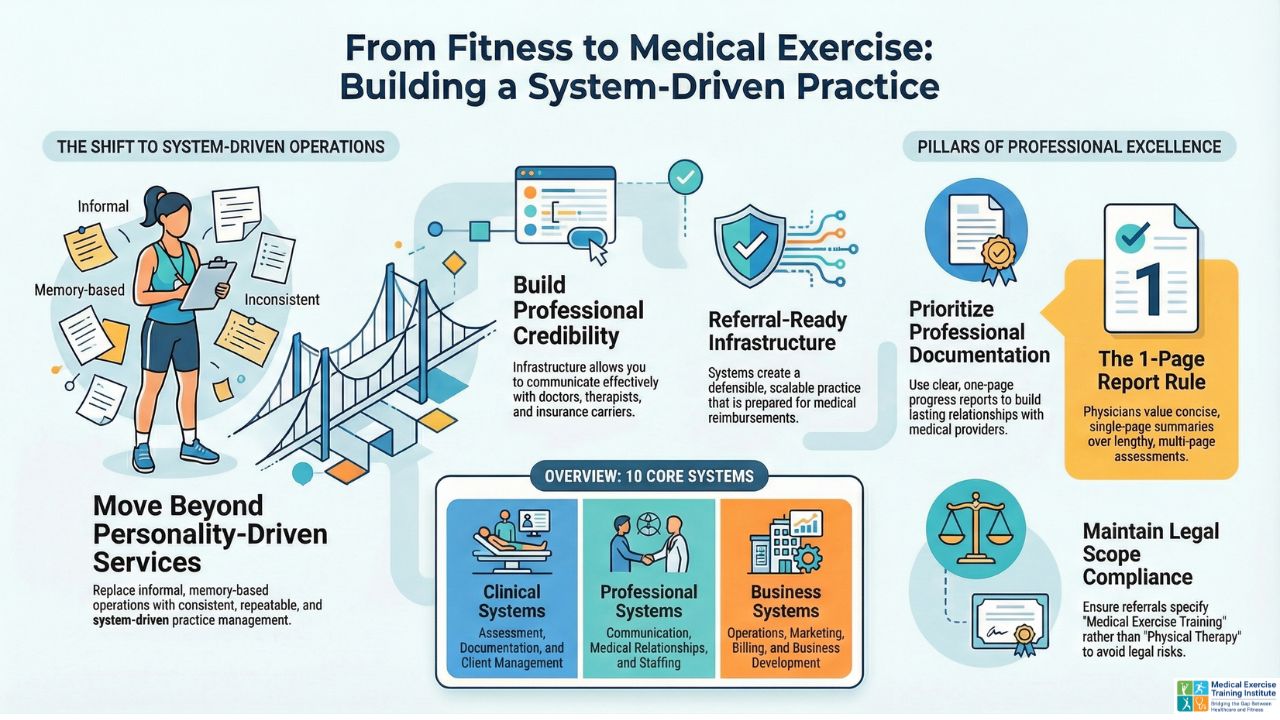
Skill Without Systems Creates Fragility
Certifications matter. Education matters. Competence matters. However, knowledge without structure produces instability.
Certifications alone will not give you confidence when speaking to physicians. They will not protect you legally. They will not produce measurable functional outcomes. They will not build referral relationships. And they will not sustain a profitable practice.
Professional credibility is constructed through integrated systems. These systems form the architecture of a real practice:
- A structured documentation system
- A consistent physician communication process
- Clearly defined billing and reimbursement boundaries
- Scheduling governance
- Targeted marketing clarity
- Standardized client management protocols
Without these, your operation depends on personality and improvisation. And personality does not scale. It does not transfer to staff. It does not protect you in a dispute. It does not institutionalize trust.
Systems scale. Systems protect. Systems sustain.
If your practice depends primarily on being “good in the room,” it is fragile. If it depends on structured workflows and consistent governance, it becomes defensible.
The One-Page Communication Rule
Physician communication is where many professionals overcomplicate what should be simple.
Physicians do not want multi-page reports filled with exercise descriptions. They do not want motivational commentary. They want clarity. They want brevity. They want measurable progress.
At its core, physician communication must answer three questions:
- Is the client progressing?
- Are measurable functional outcomes improving?
- Are there concerns that require attention?
One page. Clear. Concise. Professional.
Consistent written communication is one of the most powerful referral-building tools in your practice. When physicians receive structured updates that demonstrate outcome tracking and professional restraint, they begin to trust you. And trust is what produces ongoing referrals.
Marketing does not build medical relationships. Structured communication does.
Legal and Billing Boundaries Are Non-Negotiable
Professionalism requires discipline, especially in scope of practice.
A physician referral must specify medical exercise training, not physical therapy. Operating under a therapy referral without a license violates state or provincial law and places both you and your referral relationships at risk.
Scope discipline protects:
- You
- Your client
- Your referral relationships
Communication with medical offices must use HIPAA-compliant systems, such as secure digital fax platforms. All services must remain post-discharge. You must avoid diagnostic language and remain strictly within non-clinical boundaries.
Professional credibility is strengthened by restraint. When you honor boundaries consistently, physicians see that you understand your role. When you blur those lines, you erode trust.
Targeted Marketing: From Appearance to Solutions
Medical exercise marketing must evolve beyond aesthetics and general fitness language.
Individuals seeking post-discharge support are not looking for a “great workout.” They are searching for relief, safety, and condition-specific solutions. Late at night, someone recovering from a total knee replacement is not typing “best trainer near me.” They are searching for safe exercises after total knee replacement or exercise options for chronic low back pain.
Your messaging must speak directly to those condition-specific concerns. It must be clear, simple, and solution-oriented.
When your communication addresses real functional problems rather than showcasing physique or performance, you attract the right clients and the right referral sources. You position yourself as a problem solver, not a fitness provider.
This distinction changes everything.
The 6-Point Client Management System: Eliminating Guesswork
Random exercise produces random outcomes. In medical exercise, random outcomes are unacceptable.
Structured client governance eliminates guesswork and protects both the professional and the client. A disciplined 6-Point Client Management System includes:
- Clinical Anatomy and Pathology – Begin with the diagnosis and fully understand the condition.
- Contraindications – Identify what must be avoided before determining what to implement.
- Assessment – Establish measurable baselines. No assumptions.
- Indicated Activities – Prescribe purposeful, condition-specific exercise interventions.
- Progression and Functional Goals – Advance only when objective criteria are met.
- Protocol-Based Application – Ensure consistency and reduce oversight.
This structure allows you to manage the condition responsibly while training the client effectively. It ensures that programming decisions are defensible, measurable, and replicable.
Without structure, progression becomes emotional. Programming becomes reactive. Outcomes become inconsistent.
Structure builds defensibility. Defensibility builds trust. Trust builds referrals.
Standardization: The Healthcare Mindset
Hospitals do not allow staff to improvise care based on what “feels right.” They operate within standardized procedures and protocols. That is why they function predictably.
Your practice must adopt the same mindset.
Standardization ensures:
- Consistent client management
- No critical steps are skipped
- Measurable outcomes are tracked
- Staff performance is replicable
Without standardization, your practice remains dependent on individual effort. With standardization, your practice becomes institutional. Institutional practices earn respect because they demonstrate predictability and governance.
Predictability is professionalism.
The Golden Era of Medical Exercise
We are entering a significant period of opportunity for structured medical exercise practices. Aging populations, increasing chronic disease, shortened therapy durations, and insurance limitations are widening the post-discharge gap.
That gap requires structured professionals who understand both exercise and infrastructure.
The opportunity is enormous. But opportunity alone does not guarantee success. Only professionals who operate with systems will be positioned to lead.
This is not a casual industry shift. It is a 20-year window.
Those who install infrastructure will thrive. Those who rely on personality and improvisation will struggle.
The Real Question
The question is not whether you are skilled.
The question is whether you are structured.
Are you operating as a trainer who speaks medical language? Or as a professional who has installed practice infrastructure?
Skill attracts clients temporarily. Systems sustain practices permanently.
Your Next Steps
If your infrastructure is incomplete, begin installing it deliberately:
- Implement standardized client management protocols
- Establish one-page physician communication
- Audit and reinforce your legal boundaries
- Clarify condition-specific marketing messaging
- Integrate practice-wide systems
Then revisit the MedExPRO Operating System series and evaluate your structure honestly.
We are not in the business of workouts.
We are in the business of measurable functional outcomes.
We are here to bridge the gap between healthcare and fitness.
And bridging that gap requires infrastructure.
— Dr. Mike
Get Medical Exercise Training guidelines and updates!
Build your practice with tips learned over 28+ years teaching MedXPROs around the world!!