
The 7 Steps of a Medical Exercise Assessment
Download the Podcast Here
The Professional Framework That Separates MedExPROs From Personal Trainers
Most exercise professionals believe they perform assessments.
But the reality is this:
Most “assessments” in the fitness industry are simply movement warm-ups disguised as evaluation.
A true Medical Exercise Assessment is something very different.
It is a structured process designed to:
- Identify functional deficits
• Establish objective baselines
• Guide exercise prescription
• Communicate with medical providers
• Track functional improvement over time
Without a structured assessment process, exercise becomes guesswork.
And guesswork is the fastest way to lose credibility with physicians, physical therapists, and insurance carriers.
If Medical Exercise Professionals want to be recognized as part of the continuum of movement care, we must operate with the same level of structured evaluation used in healthcare.
Over the past three decades, I’ve refined what I call the Seven...
The Three Frameworks That Turn Exercise Skills Into a Medical Exercise Practice

Most professionals entering medical exercise believe success comes from mastering programming techniques.
But the truth is far more structural — practices fail not because of poor exercise selection, but because they lack architecture.
The MedExPRO Operating System introduces three interlocking frameworks that transform a technician into a practice owner. These frameworks create the guidelines required to produce consistency, measurable outcomes, and professional credibility.
If you want a practice that physicians trust and clients rely on, these frameworks are not optional — they are foundational.
The Core Problem — Skill Without Structure
Many professionals operate with excellent exercise knowledge yet struggle with inconsistency, unpredictable revenue, and limited referrals.
Why? Because exercise skills alone cannot sustain a practice.
Without governance structures, decisions become reactive, operations become personality-dependent, and growth becomes impossible.
The operati...
Day 10 – Standardize Your Assessments to Elevate Your Practice
If you can’t measure it, you can’t manage it. And if you can’t prove it, doctors won’t refer.
On Day 10 of our “Referral-Ready in 30 Days” Challenge, we shift our focus to one of the most critical—but often overlooked—components of a professional medical exercise practice: using standardized assessment tools to track client progress. Click the play button to watch the session recording.
Doctors don’t rely on guesswork—and neither should you.
Implementing objective, repeatable tools allows you to:
- ✅ Establish a clinical baseline for each client
- ✅ Track measurable progress over time
- ✅ Modify exercise programming based on real data
- ✅ Communicate outcomes with clarity to referring professionals
The best part? You don’t need expensive equipment or complex systems. In this session, we’ll review essential assessments that every MedExPRO should be using, including:
- Range of Motion (ROM) measurements
- Manual muscle testing or resistance-based strength indicators
- Static and dyna ...
MedExPRO: Crafting a Professional Bio That Builds Trust and Opens Referral Doors
A polished, compelling professional bio isn’t just a formality—it’s a vital tool that helps medical professionals understand who you are, what you do, and why they can trust you with their patients. Day 6 of our Referral-Ready in 30 Days Challenge focuses on exactly that: creating a professional bio that builds confidence and opens referral pathways.
Whether you’re submitting your bio as part of your marketing kit for a local physician’s office or featuring it on your website, your bio should do three key things:
- Position Yourself as a Medically-Savvy Exercise Professional
Your bio should clearly define your scope of practice and highlight your post-rehab experience. This isn’t the time to lead with general fitness accolades—focus on your ability to manage clients with conditions like joint replacements, hypertension, or stroke recovery. - Showcase Real-World Results and Credentials
A list of certifications isn’t enough. Include actual outcomes you've helped clients achieve and emph ...
MedExPRO - Define, List & Present Your MET Services
One of the most common reasons physicians don’t refer to Medical Exercise Professionals has nothing to do with your expertise—it’s because they don’t understand what you do.
And it’s not their fault.
Physicians operate in a fast-paced, outcome-driven environment. They need clarity, structure, and immediate confidence that the professional they refer to knows how to produce results and communicate them professionally.
That’s why Day 4 in your 30-Day Referral-Ready Plan is to “List Your Services Clearly.”
Why Clarity Is Essential for Physician Referrals
You may have all the skills in the world—but if your services aren’t presented clearly and professionally, doctors will default to safer, more familiar referral options (e.g., physical therapists or nothing at all).
A clear list of services gives physicians:
- A sense of safety and structure
- Confidence in your professionalism
- A quick understanding of how you support their patients after therapy ends
Think of your service menu ...
Day 2: Craft Your Elevator Pitch – The Key to Getting Noticed by Medical Professionals
Let’s face it—most Medical Exercise Professionals stumble when asked, “What do you do?”
You’re not alone. And no, saying “I do post-rehab” or “I help people exercise after therapy” won’t cut it if you want real referrals from physicians, physical therapists, and case managers.
You need a crystal-clear, 30-second pitch that positions you as a professional solution to a medical problem. This is your verbal business card—the message that plants a seed in someone’s mind that you are the go-to resource when exercise is part of the treatment plan.
So What Makes a Great Medical Exercise Elevator Pitch?
It should answer three questions—fast:
-
Who You Are
-
What You Do
-
How You Do It
- Who You Do It To
Here is the framework for the elevator speech;
Hello, my name is [Your Full Name].
I am a [insert your certification: Medical Exercise Specialist] and I develop medically-based exercise programs for individuals with [medical conditions you specialize in], especially after t
...
The Road to Medical Referrals Starts Here—with Clarity
Day 1: Clarify Your Niche – The First Step to Becoming Referral-Ready
If you’re serious about building a medical exercise practice that earns consistent physician referrals, you must start with clarity—specifically, clarity about your niche.
Your niche isn’t just a marketing tool. It’s the foundation for every system, protocol, and referral relationship you’ll develop in your business. When a physician considers sending a patient your way, the first question they unconsciously ask is:
“What type of clients does this professional really specialize in?”
If that answer isn’t immediately clear—or worse, if you try to be everything to everyone—you become invisible.
What Is a Niche in Medical Exercise?
In the context of medical exercise training, your niche is the specific group of clients or set of medical conditions you are uniquely prepared to manage using structured, outcome-driven exercise.
It’s not enough to say, “I help people get stronger after therapy.”
You need to be able t...
How to Build a Physician-Referral Ready Medical Exercise Practice in Just 30 Days
If you’re a MedExPRO trying to grow your practice with consistent physician referrals, here’s the truth:
It’s not about certifications.
It’s not about your passion.
It’s about positioning, systems, and professional communication.
Physicians want to refer.
But they’ll only do so when they’re confident you can protect their patients, document outcomes, and function as an extension of their care.
That’s why we’re launching a 30-Day Referral-Ready Plan—a step-by-step roadmap to help you build the systems, documentation, and credibility you need to become a trusted referral partner.
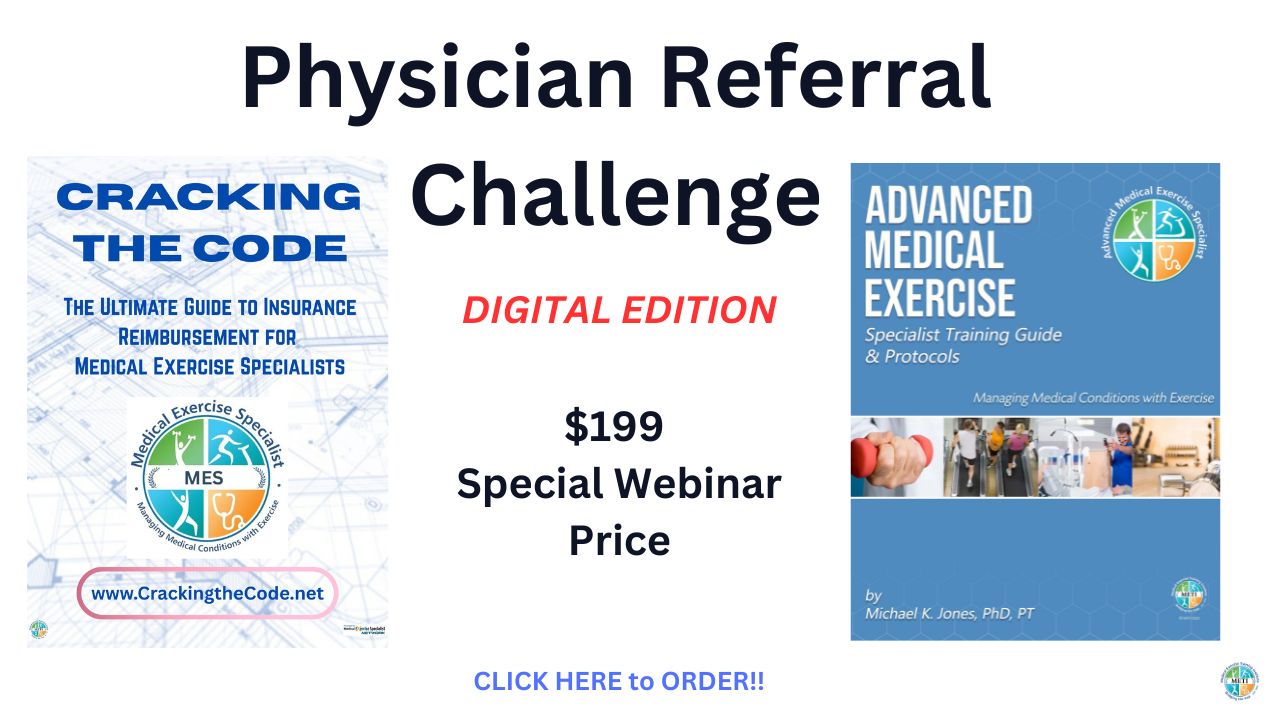
Click the Image Above to Order!!
The 30-Day Referral-Ready Plan
Here’s a preview of the four-week structure we’ll unveil during Friday’s Cracking the Code webinar:
✅ Week 1: Position Your Practice for Referrals
- Define your client niche
- Align your branding and messaging with healthcare language
- Create physician-facing materials that command trust
✅ Week 2: Document Like a Healthcare Profession...
Medical Exercise Specialist..... Do You Need to Overcome Impostor Syndrome?
Impostor syndrome among Medical Exercise Specialists (MES) is not uncommon. In this post, Dr Mike discusses how Impostor syndrome happens when MES professionals doubt their skills, even after extensive training. During client assessments, this uncertainty can cause MESs to rely too heavily on basic personal training techniques, ignoring important aspects of medical exercise assessments such as anatomy or pathology. Avoiding these crucial points prevents specialists from effectively using their advanced training.
Another common sign of impostor syndrome is avoiding communication with doctors, therapists, and chiropractors who refer clients. Professionals might fear being asked questions they can't answer, but these medical providers mainly want updates about the exercise plan and progress—not medical diagnoses or treatments. Clear communication with medical providers is important for building professional credibility.
Having certifications alone doesn't build confidence. Confidence gr...
Unlocking Insurance Success: The Essential Guide for Medical Exercise Professionals
Medical Exercise Training (MET) is rapidly becoming a sought-after service among healthcare providers and clients with medical conditions. However, effectively integrating medical referrals and successfully navigating insurance reimbursement can pose significant challenges if your practice isn't structured properly. In our recent webinar, we reviewed the essential components required to consistently deliver medical exercise services, ensure compliance, and streamline insurance claim submissions.
During this Cracking the Code webinar, we covered critical aspects every medical exercise professional must master:
✅ Scope of Practice & Ethical Compliance – Essential guidelines to remain within legal boundaries while building credibility.
✅ Structured Client Intake System – Standardizing client onboarding, including crucial documentation to protect your practice.
✅ Standardized Assessments & Documentation – Conducting precise assessments that establish medical necessity and functional baselines....