
The 7 Steps of a Medical Exercise Assessment
Download the Podcast Here
The Professional Framework That Separates MedExPROs From Personal Trainers
Most exercise professionals believe they perform assessments.
But the reality is this:
Most “assessments” in the fitness industry are simply movement warm-ups disguised as evaluation.
A true Medical Exercise Assessment is something very different.
It is a structured process designed to:
- Identify functional deficits
• Establish objective baselines
• Guide exercise prescription
• Communicate with medical providers
• Track functional improvement over time
Without a structured assessment process, exercise becomes guesswork.
And guesswork is the fastest way to lose credibility with physicians, physical therapists, and insurance carriers.
If Medical Exercise Professionals want to be recognized as part of the continuum of movement care, we must operate with the same level of structured evaluation used in healthcare.
Over the past three decades, I’ve refined what I call the Seven-Step Medical Exercise Assessment Framework.
This framework provides a systematic method for evaluating clients with medical conditions while staying within the scope of Medical Exercise Training.
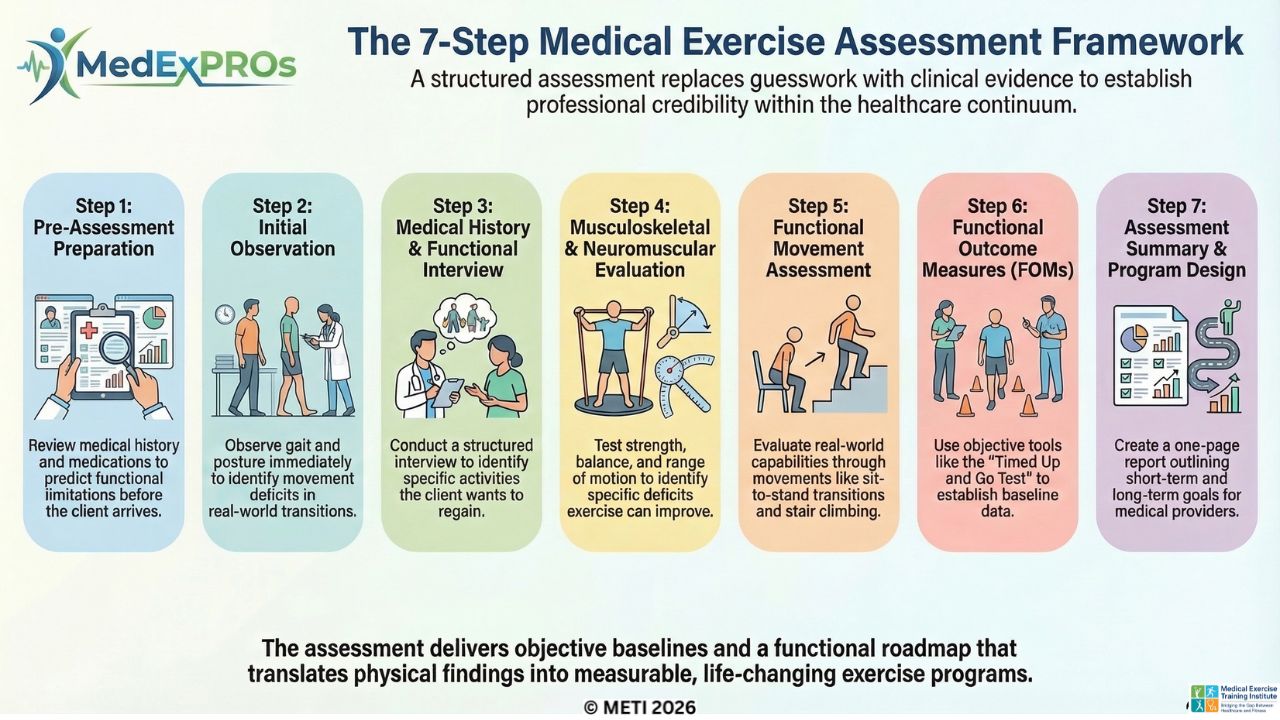
Step 1
Pre-Assessment Preparation
The assessment begins before the client arrives.
Professionals prepare.
Technicians improvise.
Before meeting the client, the MedExPRO should review:
- Diagnosis and medical history
• Surgical history
• Medications
• Current symptoms
• Contraindicated activities
This preparation triggers a critical thought process:
What functional limitations are likely associated with this condition?
For example, a client with Parkinson’s disease may present with:
- gait disturbances
• reduced stride length
• postural instability
• difficulty with directional changes
Understanding the anatomy and pathology of the condition allows the MedExPRO to design an assessment that focuses on meaningful functional indicators.
Without this preparation, the assessment becomes random.
Step 2
Initial Observation
The moment you see the client move, the assessment has already begun.
Observation is one of the most powerful tools a Medical Exercise Professional possesses.
Pay attention to:
- posture
• gait pattern
• movement initiation
• balance
• hand dexterity
• facial expression
These observations often reveal functional deficits before any formal test begins.
For example:
A client may walk well in a straight line but demonstrate instability when turning or navigating obstacles.
Those real-world movement patterns are far more meaningful than isolated strength tests.
Step 3
Medical History & Functional Interview
The next step is a structured conversation.
The purpose is not simply to collect medical information.
It is to understand how the condition affects daily life.
Important questions include:
- What activities are most difficult?
• When are symptoms at their worst?
• What activities have been lost?
• What activities does the client want to regain?
This conversation helps identify functional goals, which will guide the exercise program.
For example:
A client may say:
“I want to walk to the end of the block with my grandchildren.”
That becomes a measurable functional outcome.
Step 4
Musculoskeletal & Neuromuscular Evaluation
Now the formal testing begins.
This phase evaluates key physical components including:
- strength
• range of motion
• balance
• coordination
• stability
• endurance
The goal is not to perform a full clinical examination.
Instead, the MedExPRO identifies functional deficits that exercise can improve.
For example:
- weak gluteal muscles affecting gait
• limited hip mobility affecting stride length
• poor balance during directional changes
Each of these findings will influence exercise selection.
Step 5
Functional Movement Assessment
This is the most important step of the entire process.
Medical Exercise Professionals are functional specialists.
That means we must evaluate how the client moves in real-world environments.
Examples include:
- sit-to-stand transitions
• walking and turning
• navigating obstacles
• reaching and bending
• stair climbing
These movements reveal whether strength and mobility translate into functional capability.
Step 6
Functional Outcome Measures
Healthcare professionals rely on objective measurement tools.
These are known as Functional Outcome Measures (FOMs).
Examples include:
- Tinetti Balance and Gait Scale
• Timed Up and Go Test
• Functional Reach Test
• Six Minute Walk Test
These tools provide something extremely valuable:
a baseline.
This baseline allows the MedExPRO to track progress over time and demonstrate improvement in measurable terms.
Physicians trust numbers.
Numbers create credibility.
Step 7
Assessment Summary & Program Design
The final step is translating the findings into a structured plan.
This includes:
- identification of functional deficits
• short-term goals (30 days)
• long-term goals (60–90 days)
• recommended exercise frequency
• general program strategy
The results should be summarized in a clear one-page report that can be shared with:
- physicians
- physical therapists
- chiropractors
- insurance carriers
This document becomes the foundation of the exercise program moving forward.
Why the Assessment Defines the Profession
The Medical Exercise Assessment is not just a procedural step.
It defines the professional identity of the MedExPRO.
Personal trainers focus on workouts.
Medical Exercise Professionals focus on function.
The assessment allows us to answer the most important question in healthcare-based exercise:
What functional limitations are preventing this client from living the life they want?
Once that question is answered, the exercise program becomes purposeful.
Key Takeaways for MedExPROs
- The assessment begins before the client arrives.
Preparation and pathology knowledge guide the entire process. - Observation often reveals more than formal testing.
Real-world movement patterns provide critical insights. - Functional outcome measures create credibility.
Numbers demonstrate progress to physicians and insurance providers. - The assessment is the bedrock of the exercise program.
Every exercise should address a specific functional deficit.
Final Thought
If you focus only on exercise, you are a trainer.
If you focus on function, you are a Medical Exercise Professional.
And that distinction begins with a structured assessment.
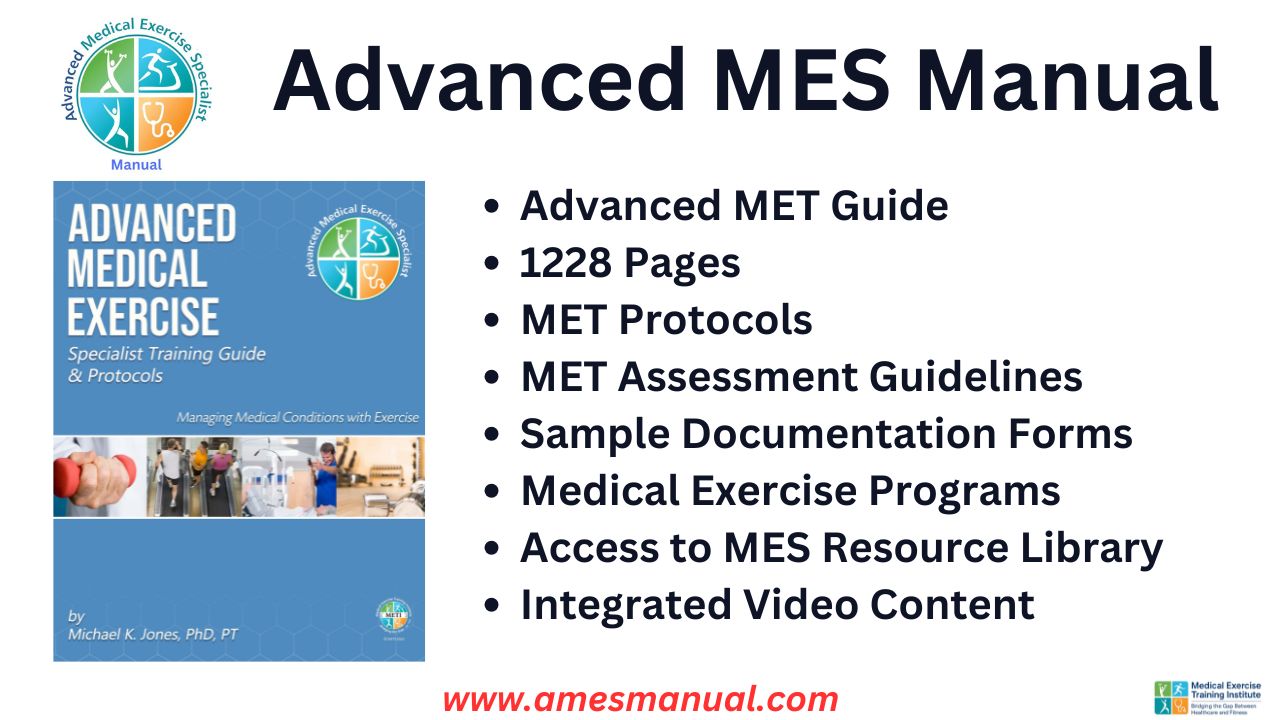
Assess like a Medical Exercise Professional - Order the AMES Manual below.
Get Medical Exercise Training guidelines and updates!
Build your practice with tips learned over 28+ years teaching MedXPROs around the world!!