
“PT” Has Different Meanings in Different Settings
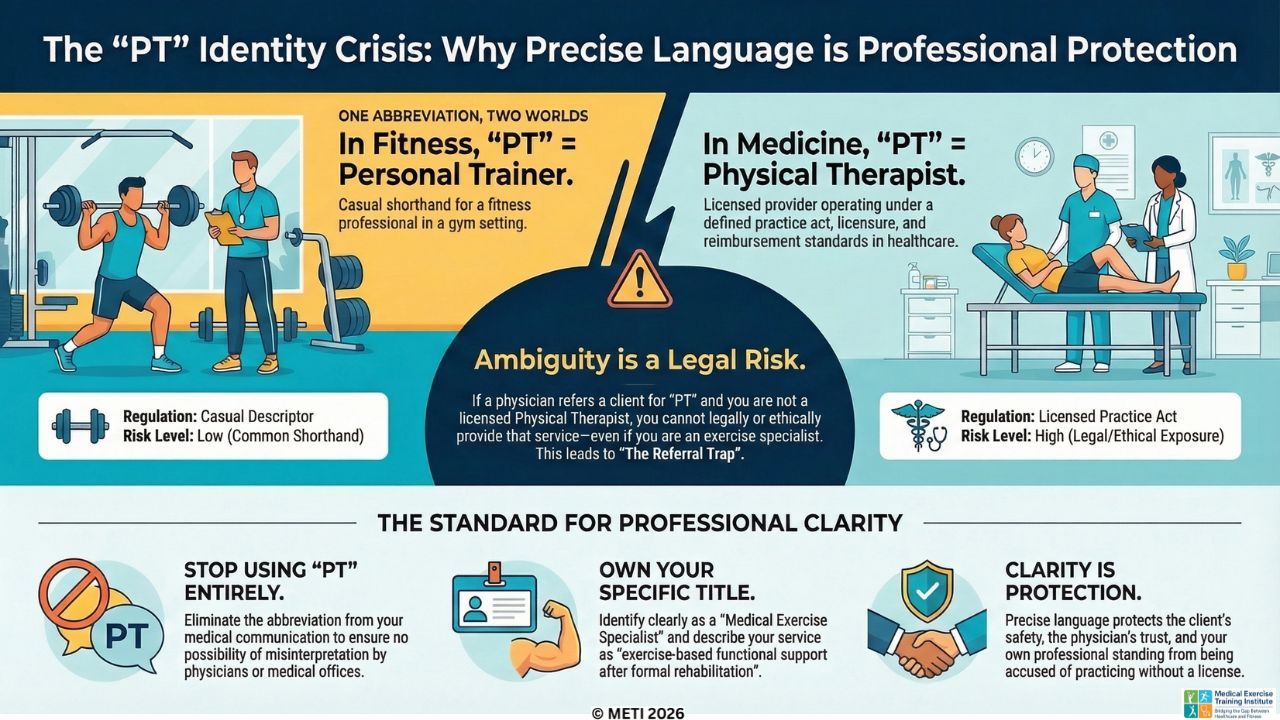
When the Medical Community Hears “PT”—It’s Not “Personal Trainer”
Why Medical Exercise Professionals Must Speak Clearly Before They Step Into Medical Communication
As Medical Exercise Professionals move closer to the healthcare system, one truth becomes increasingly important….
Language Matters.
And sometimes, one small abbreviation can create a very big problem.
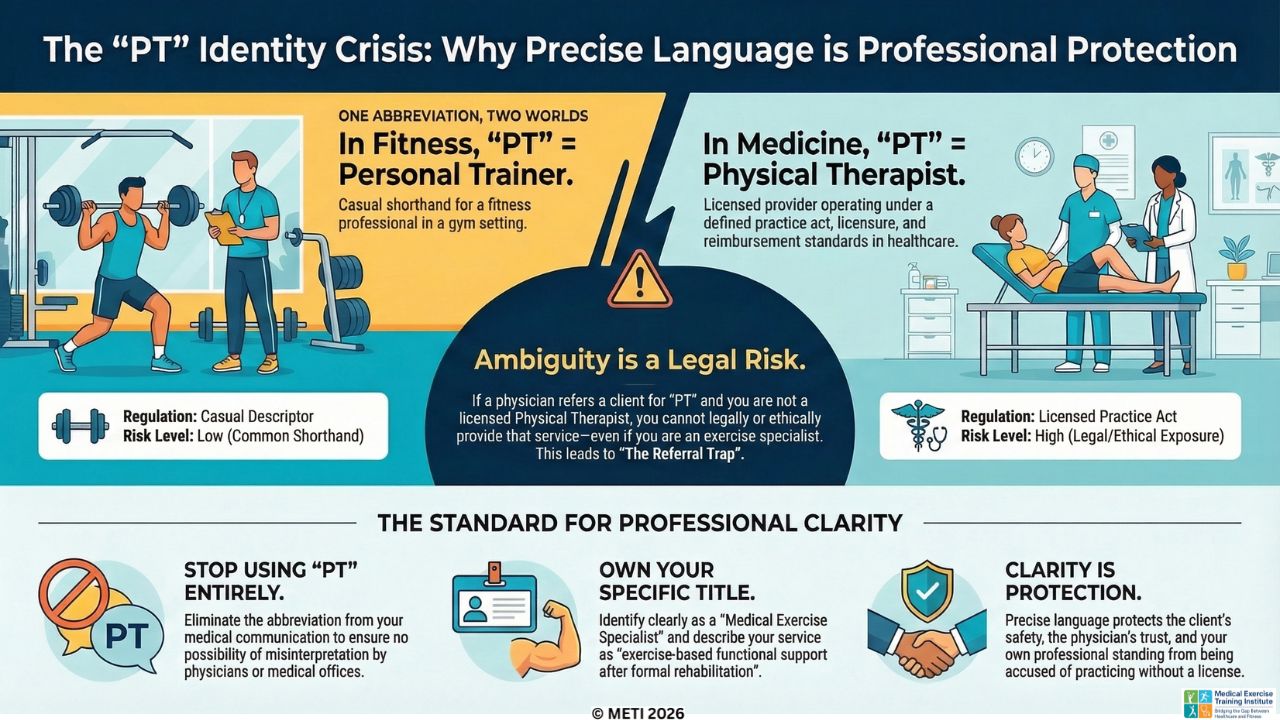
Recently, we encountered a situation in which a Medical Exercise Specialist contacted a physician to obtain a referral for medical exercise training services. The physician wrote the referral for physical therapy services. The Medical Exercise Professional continued working with the client anyway, while attempting to get the wording corrected later.
That is not a minor paperwork issue.
That is a professional, ethical, and potentially legal problem.
The root of the confusion came down to a simple abbreviation: PT.
In the fitness world, some people may casually use “PT” to mean personal trainer. But inside the medical community, “PT” overwhelmingly means physical therapy or physical therapist. There is very little ambiguity there. What may feel casual in the fitness setting can become dangerously unclear in the medical setting.
And that is exactly why Medical Exercise Professionals must become much more disciplined in how they identify themselves, describe their services, and communicate with medical providers.
Different Settings, Different Language
One of the great mistakes professionals make when trying to bridge the gap between healthcare and fitness is assuming that words carry the same meaning in both environments.
They do not.
In the fitness setting, abbreviations, shorthand, and casual descriptors may be common. In the medical setting, terminology is attached to scope of practice, licensure, reimbursement, legal standards, and patient protection laws.
That changes everything.
When a physician hears “PT,” they are not thinking “personal trainer.” They are thinking physical therapist. They are thinking about a licensed healthcare provider operating under a defined practice act.
So when a Medical Exercise Professional introduces himself vaguely, uses unclear terminology, or fails to distinctly identify his role, he is creating confusion where precision is required.
That confusion can lead to the wrong referral, the wrong expectations, the wrong documentation, and the wrong legal exposure.
Clarity Is Not Optional
Let me say this plainly:
If you are a Medical Exercise Specialist, Post-Rehab Conditioning Specialist, Medical Fitness Specialist, or any other exercise-based professional, you must be clear, direct, and unmistakable when communicating with physicians and other medical providers.
You are not there to diagnose.
You are not there to treat.
You are not there to provide modalities beyond exercise.
You are not a licensed rehabilitation provider.
Your service is exercise. Structured, professional, medically informed exercise—but exercise nonetheless.
That distinction is not something to hide from. It is something to own.
The Medical Exercise Professional who communicates clearly protects the client, protects the physician relationship, protects the profession, and protects himself.
The one who communicates vaguely creates unnecessary risk for everyone involved.
The Referral Must Match the Service
This is where many professionals get themselves into trouble.
If a referral says physical therapy, then the referred service is physical therapy.
That does not become medical exercise training simply because an exercise professional received it.
If the referral language includes physical therapy terminology or requests services that fall under a physical therapy practice act, that referral belongs to a licensed physical therapist.
Period.
A Medical Exercise Professional cannot simply “work under it,” “interpret it loosely,” or hope to fix it later while continuing services.
That is how professionals end up in legal hot water.
If the referral is wrong, the referral must be corrected before services proceed under that referral framework.
This is one of the most important lessons MedExPROs must learn as the profession grows: you do not protect a referral by being vague. You protect a referral by being precise.
Why This Matters More Now
As Medical Exercise Training enters what I believe is a golden era, more MedExPROs are communicating with physicians, orthopedic groups, rehab providers, chiropractors, and other healthcare professionals.
That is good news.
But growth creates pressure.
And pressure exposes weaknesses.
If our profession is going to earn greater trust, more referrals, and broader recognition, then we must become better at presenting our identity with maturity and discipline.
That means:
- stating your title clearly
- describing your service accurately
- defining your exercise-only role
- avoiding abbreviations that create confusion
- making sure referral language matches the actual service being requested
This is not about insecurity. It is about professionalism.
The closer you move toward medical referral relationships, the more important it becomes to use the right language in the right setting.
Stop Borrowing Titles That Do Not Belong to You
There is another issue here that needs to be addressed.
Some exercise professionals become comfortable in medical environments and begin to blur the lines. They have worked in clinics. They have assisted rehabilitation staff. They have seen physical therapy up close. They may have completed some internal training or on-the-job instruction.
None of that makes them a physical therapist.
Exposure is not licensure.
Observation is not scope.
On-the-job training is not professional equivalence.
This is not said to diminish the experience of exercise professionals who have worked in rehabilitation settings. That experience can be valuable. But it must be understood for what it is.
The Medical Exercise Profession does not advance by pretending to be physical therapy.
It advances by clearly establishing what it is—and what it is not.
The Better Way to Communicate
Here is the standard I recommend:
When speaking with physicians, medical offices, or clients, stop using “PT” to describe yourself if there is any possibility it could be interpreted as physical therapy or physical therapist.
Instead, identify yourself with full clarity:
- “I am a Medical Exercise Specialist.”
- “I provide medical exercise training services.”
- “My role is exercise-based functional support after formal rehabilitation has concluded.”
- “I do not provide treatment, diagnosis, or licensed rehabilitation services.”
- “The referral should specify Medical Exercise Training services or Functional Conditioning services.”
That kind of clarity does not weaken your professional standing.
It strengthens it.
Because professionals who are confident in their role do not need borrowed language.
The Bigger Issue: Professional Credibility
The profession of Medical Exercise Training will not be elevated through vague claims, blurred titles, or borrowed medical language.
It will be elevated through:
- clear identity
- disciplined communication
- ethical boundaries
- defensible documentation
- measurable functional outcomes
- strong referral relationships built on trust
If we want physicians to refer to us with confidence, then they must know exactly who we are.
If we want legal safety, we must define our role before services begin.
If we want long-term professional recognition, we must stop speaking loosely in environments where precision matters.
In the fitness world, “PT” may mean personal trainer.
In the medical world, it means something very different.
And if you do not understand that difference, you can put yourself, your client, and your profession at risk.
Final Takeaway
Medical Exercise Professionals must stop assuming that abbreviations travel safely across professional settings.
They do not.
As you communicate with physicians and healthcare providers, be bold enough to be clear.
Say who you are.
Say what you do.
Say what you do not do.
And make sure every referral reflects the actual service being requested.
Because in this profession, clarity is not just good communication.
It is professional protection.
This is an important topic because it sits at the intersection of professionalism, communication, legal exposure, and the long-term credibility of the medical exercise profession.
Get Medical Exercise Training guidelines and updates!
Build your practice with tips learned over 28+ years teaching MedXPROs around the world!!