
Functional Outcome Measures (FOMs): The Currency of Trust
Most Medical Exercise Professionals believe they are outcome-driven.
They design intelligent programs.
They progress exercises appropriately.
They see improvement in their clients.
But when asked to prove it?
That’s where many practices quietly collapse.
A physician does not refer based on your passion.
An insurance carrier does not consider reimbursement based on your effort.
They respond to one thing:
Objective change
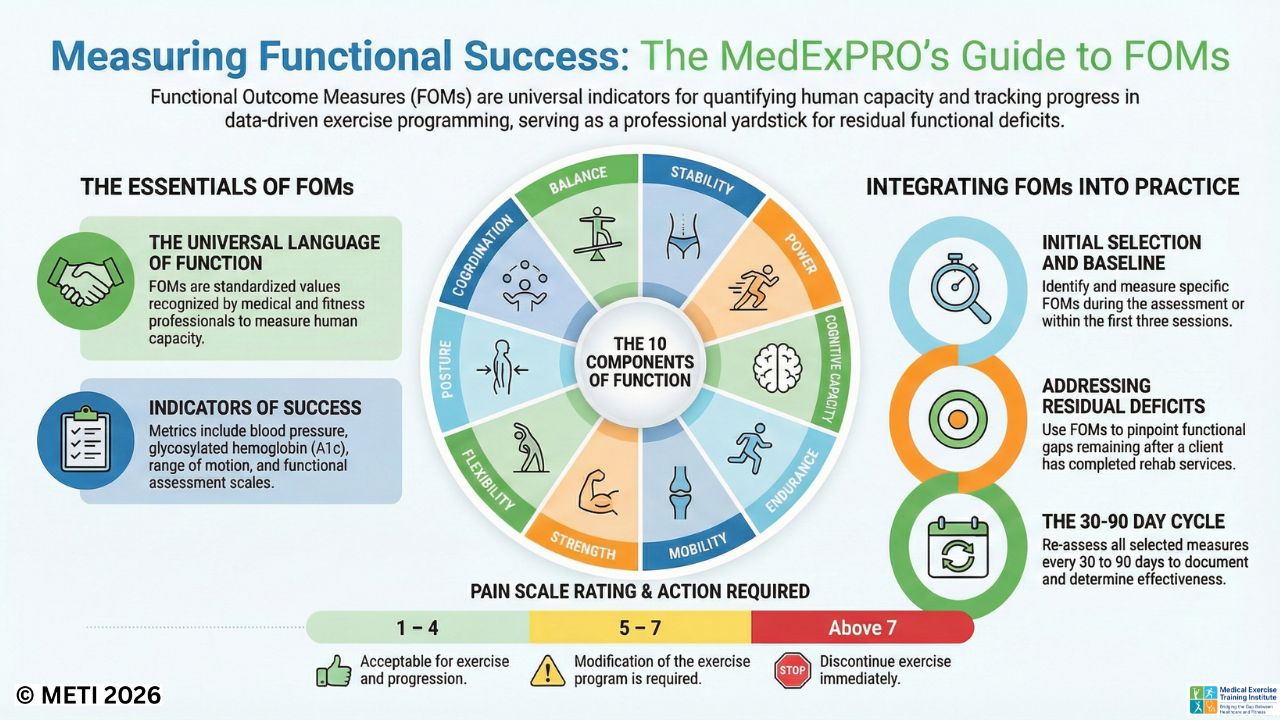
Functional Outcome Measures — FOMs — are the currency of trust in medical exercise training.
Without them, you are running sessions.
With them, you are building professional credibility.
The Core Problem: Improvement Without Proof
Many MedExPROs rely on observation and client feedback:
- “They’re moving better.”
- “Pain has decreased.”
- “They feel stronger.”
Those statements may be true.
But they are not measurable.
In a healthcare-aligned environment, improvement must be quantifiable.
If it cannot be measured, it cannot be defended.
If it cannot be defended, it cannot support referrals or reimbursement discussions.
This is where the shift must occur.
The profession cannot evolve beyond fitness-style services if we do not measure change in structured, repeatable ways.
Concept #1: Objective Measurement Is Professional Currency
When you measure:
- Range of motion
- Strength
- Balance
- Functional performance
You transform exercise sessions into documented outcomes.
You create a before and an after.
Consider a client post-discharge with shoulder limitation.
Initial assessment reveals:
- Active shoulder flexion: 110°
Six weeks later:
- Active shoulder flexion: 150°
That 40-degree improvement is not opinion.
It is evidence.
Now it becomes:
“Client improved active shoulder flexion from 110° to 150°, resulting in improved overhead functional capacity.”
Notice what happened.
Measurement became function.
Function became credibility.
That is professional currency.
Concept #2: Measurement Must Be Systemized, Not Occasional
Measurement cannot be random.
It must be installed into your client management system.
Without structure, FOMs become inconsistent.
Without consistency, they become unreliable.
A professional practice integrates outcome measurement at predictable checkpoints:
- At intake
- At scheduled reassessment intervals
- At discharge or milestone completion
When reassessments are systemized, you can:
- Track trends
- Demonstrate progression
- Identify plateaus
- Adjust programming objectively
Imagine a client presenting with balance deficits.
Initial assessment:
- Single-leg stance: 4 seconds
Midpoint reassessment:
- 11 seconds
Final reassessment:
- 18 seconds
Now the documentation reads:
“Improved single-leg stance time from 4 seconds to 18 seconds, demonstrating enhanced neuromuscular control and reduced fall risk.”
That progression tells a story.
A measurable story.
And stories supported by data are what physicians trust.
Concept #3: Data Must Be Translated Into Functional Language
Numbers alone are not persuasive.
A physician does not simply want to see:
“Strength improved from 3/5 to 4+/5.”
They want to understand what that means functionally.
So you must translate the metric.
Instead of writing:
“Quadriceps strength improved.”
You write:
“Quadriceps strength improved from 3/5 to 4+/5, resulting in improved sit-to-stand efficiency and stair negotiation tolerance.”
The measurement now connects to life.
This is the bridge between fitness-style documentation and professional medical exercise reporting.
The sequence must always be:
Measurement → Functional Impact → Practical Outcome
That structure communicates professionalism.
The System-Level Shift
Functional Outcome Measures are not an “extra form.”
They are part of your infrastructure.
They support:
- Client management
- Documentation
- Communication with medical providers
- Reimbursement preparation
- Professional identity
Without FOMs, you are session-driven.
With FOMs, you are outcome-driven.
This distinction determines whether you are viewed as a trainer… or a Medical Exercise Professional.
The Professional Standard
If we want:
- Physician referrals
- Insurance conversations
- Professional recognition
Then we must operate at a standard that produces measurable, defensible outcomes.
The Advanced Medical Exercise Specialist Manual provides the structured assessment and documentation frameworks necessary to systemize FOMs.
The Cracking the Code Manual explains how documentation and objective progress support reimbursement discussions.
This is not about more paperwork.
It is about professional architecture.
Three Key Takeaways
- Improvement must be measurable to build professional trust.
- Functional Outcome Measures must be systemized within your client management process.
- Data must be translated into functional language to support referrals and reimbursement readiness.
Next Steps (Simple and Implementable)
Start small.
- Identify four core measures you will consistently use:
- ROM
- Strength
- Balance
- One functional performance measure
- Install reassessment checkpoints into your schedule.
- Begin translating your measurements into functional outcome statements.
Do not overwhelm yourself.
Install one system at a time.
Call to Action
If you are committed to building a referral-ready and reimbursement-ready practice, you must master structured outcome measurement.
Study the assessment frameworks in the Advanced Medical Exercise Specialist Manual.
Learn how to align documentation with reimbursement preparation in the Cracking the Code Manual.
Do not simply deliver exercise.
Deliver measurable outcomes.
That is how trust is earned.
That is how professionalism is built.
That is how the Medical Exercise profession advances.
- Dr. Mike
Get Medical Exercise Training guidelines and updates!
Build your practice with tips learned over 28+ years teaching MedXPROs around the world!!